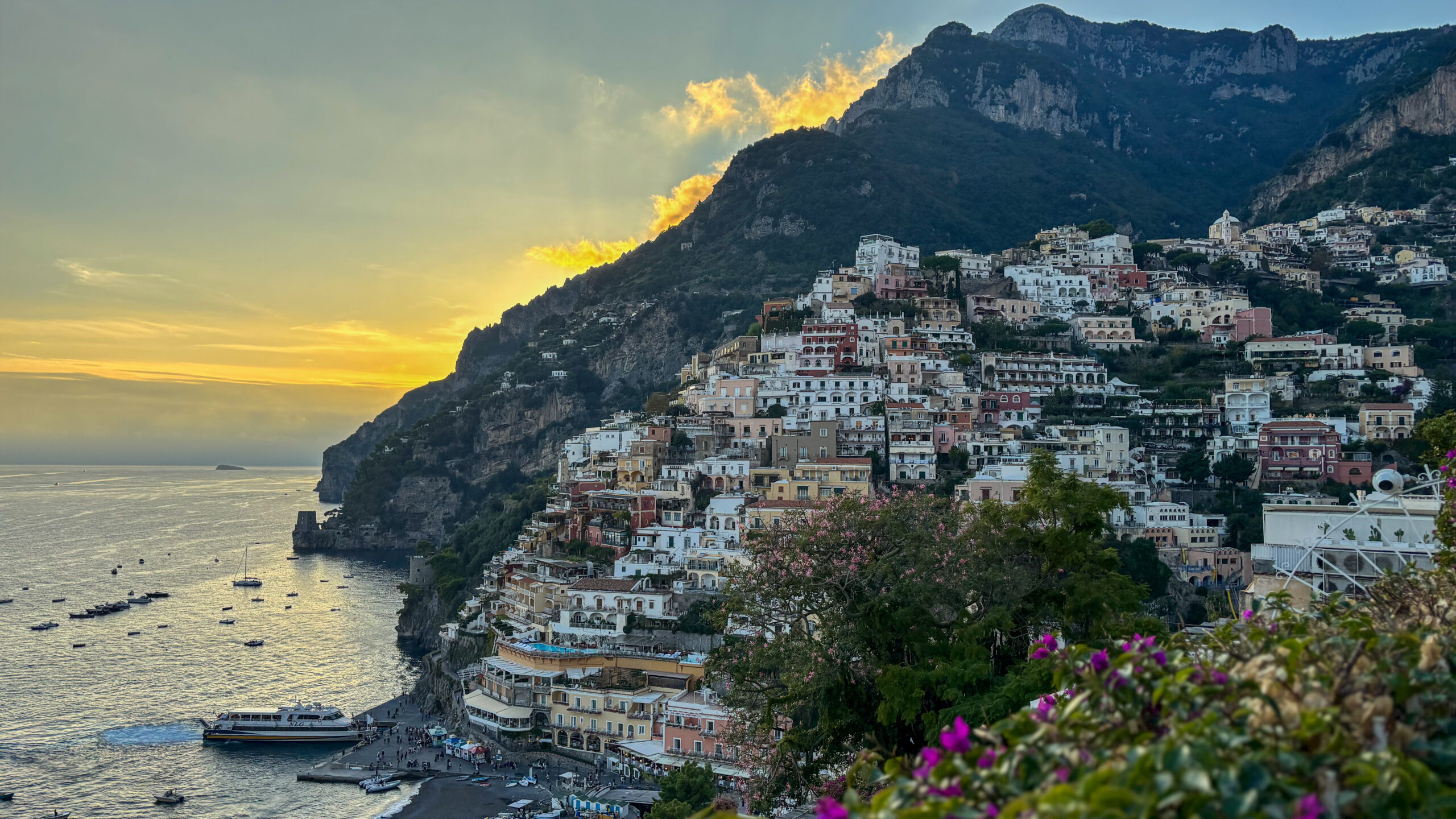
Dreaming of rolling Tuscan hills, cliffside villages on the Amalfi Coast and fairytale towns straight out of a storybook? This 8 day Italy road trip takes you through some of the country’s most beautiful destinations – from Val d’Orcia to Positano, Ravello and Alberobello.
This itinerary is based on our own trip through Italy and includes practical tips, hotel recommendations, driving advice, and a few mistakes we’d avoid next time.
Affiliate disclosure: This post contains affiliate links. If you book through one of these links, I may earn a small commission at no additional cost to you.
8 Day Italy Road Trip Overview
- Duration: 8 Days
- Starting Point: Rome
- Ending Point: Rome
- Best Time to Visit: April – June & September – October
- Rental Car Required – Highly recommended for Tuscany and Puglia; less convenient within Positano, Amalfi and Ravello
- Family Friendly – Yes
- Total Driving Distance: Approximately 1,500 km
| Day | Route | Overnight |
| Day 1 | Rome → Val d’Orcia | Tuscany |
| Day 2 | Crete Senesi, Asciano and Monteriggioni | Tuscany |
| Day 3 | Pienza → Pitigliano → Saturnia → Rome | Rome |
| Day 4 | Rome → Positano | Positano |
| Day 5 | Amalfi → Ravello | Ravello |
| Day 6 | Ravello → Alberobello | Alberobello |
| Day 7 | Explore Alberobello | Alberobello |
| Day 8 | Alberobello → Rome | Rome |
Driving in Italy: What to Know Before This Road Trip
Having a rental car gave us the freedom to explore Tuscany’s countryside, stop at viewpoints whenever we wanted, and travel between smaller towns that would have been difficult to reach by public transport. However, driving in Italy comes with a few rules and challenges that are worth understanding before you collect your car.
Driving Licence Requirements
Check the driving requirements for the country that issued your license before travelling. Canadian visitors can drive in Italy with a valid Canadian driver’s license.
Your rental company may also have its own requirements, so confirm exactly which documents you need before departure and carry your licence, rental agreement, passport and insurance information whenever you drive.
Watch Carefully for ZTL Zones
Many historic Italian towns and cities have restricted traffic areas called ZTLs, or Zona a Traffico Limitato. These zones are commonly found around historic centres, and access may be limited to residents and authorized vehicles.
Entrances are usually marked with signs and are monitored by cameras. Do not follow another vehicle into a historic centre unless you are certain your rental car is authorized. Even when Google Maps suggests a route, check the road signs yourself.
Our approach was simple: park outside the historic centre and walk in. This saved us from navigating narrow streets and reduced the risk of accidentally entering a restricted zone.
If your accommodation is inside a ZTL, contact the property before arrival. Some hotels can register a guest’s licence plate temporarily, but never assume this happens automatically.
Toll Roads
Many of Italy’s major motorways are toll roads. The amount normally depends on the distance travelled and the type of vehicle.
Keep your motorway ticket until you exit, and follow the lane signs carefully when approaching the toll booths. Payment options can include cash, credit or debit card, and electronic toll systems. Avoid entering lanes reserved exclusively for Telepass unless your rental car is equipped with one.
Parking
Parking can be one of the most stressful parts of driving in Italy, particularly in historic towns and along the Amalfi Coast.
Whenever possible, use an official paid parking lot outside the old town and continue on foot. Read every sign carefully, as local restrictions and parking rules can vary. Before booking accommodation, check whether parking is included, nearby or located some distance away.
Having confirmed parking beside Casa Cinque in Positano made an enormous difference for us because finding space independently in town would have been extremely difficult.
Fuel Stations
Do not wait until the tank is nearly empty, especially when driving through rural Tuscany or between smaller towns. Confirm whether your rental car takes petrol or diesel before leaving the rental desk, as using the wrong fuel can become an expensive mistake.
Keep your fuel receipt when refilling shortly before returning the car, and check whether your rental agreement requires the tank to be returned full.
Choose a Smaller Car
A compact car is usually much easier to manage on Italy’s narrow village streets, tight bends and small parking spaces. You still need enough room for your passengers, luggage and child seat, but this is not the road trip where I would choose an unnecessarily large vehicle.
Travelling With Children
Children under 1.5 metres must travel in an approved restraint system appropriate for their size. If you are renting a car seat, reserve it in advance and check the seat carefully when collecting the vehicle.
We travelled with our baby, so having the correct car seat arranged before leaving the airport was essential. It is also worth building regular breaks into long driving days rather than trying to cover everything in one stretch.
Driving the Amalfi Coast
The Amalfi Coast is beautiful, but driving there requires confidence and patience. The roads are narrow and winding, buses and cars often pass extremely close together, and parking is limited and expensive.
If you are not comfortable with tight mountain roads, consider leaving the car at your accommodation and using ferries, buses or private transfers to explore the coast. Even confident drivers should avoid rushing and allow much more time than the distance on the map suggests.
For Tuscany and Puglia, having a car was one of the best decisions we made. For the Amalfi Coast, it was useful mainly because our accommodations had confirmed parking.
Book your rental car here.
Day 1: Driving from Rome to Tuscany’s Dreamiest Countryside
Our Italian adventure began the moment we landed in Rome. Rather than spending a few days in the capital, we picked up our rental car at Rome Fiumicino Airport and headed straight for Tuscany. If you’re planning a similar trip, I can’t recommend this enough. Tuscany is one of those places that truly rewards having your own vehicle. The freedom to stop at viewpoints, explore hidden villages, and take scenic detours is part of the experience itself.
Before leaving the airport, we activated our Airalo Italy eSIM. Having reliable data from the moment we landed made navigating the country incredibly easy. Whether we were using Google Maps to find our next destination, searching for restaurants, or discovering unexpected photo stops along the way, staying connected made the trip much smoother. Setup took only a few minutes, and we had data as soon as we landed.
Get your Airalo Italy eSIM here.
Rome to Val d’Orcia Drive
- Distance: Approximately 220 km
- Driving Time: 2.5 – 3 hours
- Road Conditions: Easy highways followed by scenic country roads
The drive itself felt like the perfect introduction to Tuscany. The busy highways surrounding Rome gradually gave way to winding country roads lined with vineyards, olive groves, and rolling hills. Every kilometer brought us closer to the landscapes we’d seen countless times in travel magazines and Instagram photos.
Where We Stayed: Casanova Panoramic Rooms & Suites
Check rates and availability here.
By the time we arrived, we were ready to slow down and soak it all in. We had splurged on one of the panoramic rooms with a private balcony, and it was worth every euro.
The moment we stepped outside, we were greeted by an endless sea of rolling Tuscan hills. Cypress trees dotted the landscape, golden fields stretched toward the horizon, and the late afternoon sun painted everything in warm shades of gold.
It looked exactly like the Tuscany you see in postcards – only somehow even more beautiful in person. As we sat overlooking the famous hills of Val d’Orcia, it finally hit us – we were in Tuscany.
Rather than rushing off to explore, we spent the rest of the afternoon exactly where we wanted to be: relaxing on our balcony and taking in one of the most spectacular views of the entire trip.
There was something magical about that first evening. After months of researching, planning, and counting down the days, everything finally felt real.
Dinner at La del Barbarossa
As evening approached, we headed to La del Barbarossa, the hotel’s restaurant, for our first authentic Tuscan meal. With traditional local dishes, regional wines, and panoramic views stretching across the valley, it was the perfect introduction to the region. Every bite felt fresh, authentic, and wonderfully uncomplicated -the kind of meal that reminds you why Italian food is celebrated around the world.
A Sunset We’ll Never Forget
Back in our room, we left the balcony doors open and watched the last traces of daylight disappear behind the hills. The countryside grew quiet. The stars slowly appeared overhead.
And for the first time in a long while, there was nowhere else we needed to be. It was the perfect start to our Tuscany road trip.
Travel Tip
If your budget allows, book one of the panoramic rooms with a balcony. Waking up to uninterrupted views of Val d’Orcia was one of the highlights of our entire Italy itinerary and an experience we still talk about today.
Day 2 – Crete Senesi: Viewing the Moonscape
Access & Parking: The Crete Senesi isn’t one specific place with an entrance gate – it’s a landscape region spread across clay hills between Siena and Asciano. Most of the dramatic formations you see in photos are on private farmland, which is why close access isn’t always possible.
Your best bet: drive the provincial roads (SP438 toward Asciano or around Buonconvento) and stop at roadside pull-offs when you spot stunning views. Some viewpoints have small designated parking areas, but many are just informal spots where you can safely pull over. Turn on your hazard lights if you’re stopping along curves – these roads wind quite a bit.
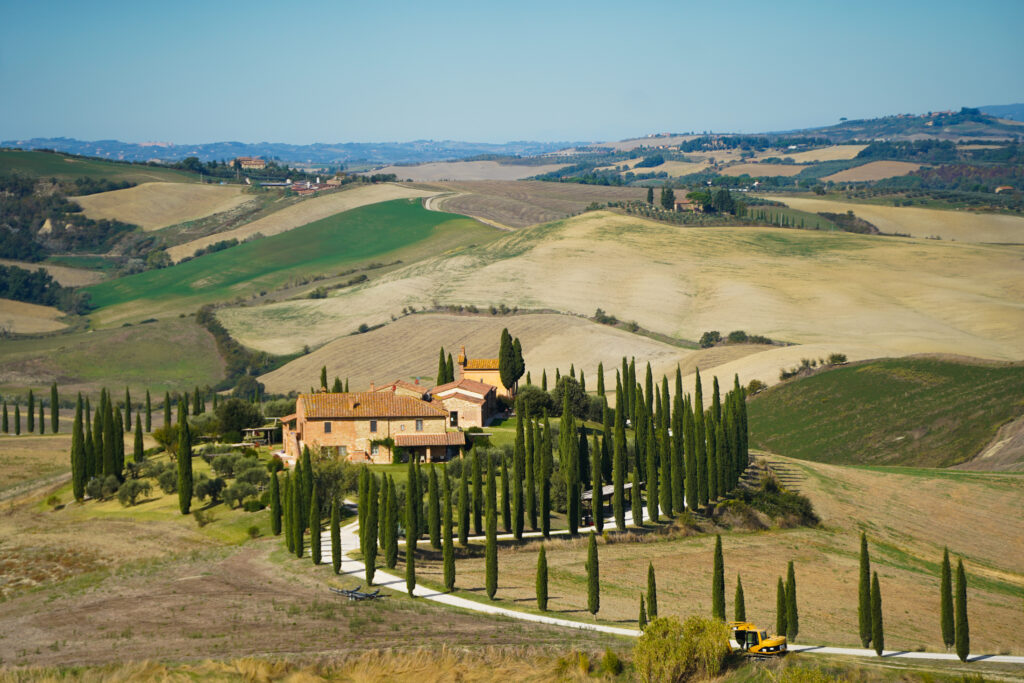
Crete Senesi – Tuscany’s famous farmhouse
Famous Photo Spot
The iconic cypress-lined road leading to Podere Baccoleno (just south of Asciano) is private property and gated. But here’s the workaround: you can photograph it beautifully from the adjacent field or from the crossroad, where there’s space for 3-4 cars to park briefly. Even from outside, the shot is worth it. The hills look sculpted, barren in the most beautiful way. We stayed and stared longer than we planned to.
Photography Tip
Visit during golden hour. The warm light and long shadows bring out every contour of the landscape and make the hills glow.
Asciano: The Quiet Town You Almost Missed
After viewing the moonlike clay hills of Crete Senesi from the roadside, we decided to explore Asciano – the small medieval town that sits at the edge of this surreal landscape.
We parked at the edge of town and wandered through the narrow streets, letting ourselves get lost in the maze of alleyways. Unlike busier Tuscan towns, Asciano felt genuinely lived-in. The streets were narrow, winding, and charming in that organic way – not designed for tourists, but welcoming to them anyway.
What makes Asciano special is how untouched it feels. The medieval architecture is preserved, the passages are tight and narrow, and you get a real sense of stepping back in time. No massive crowds. No tour groups coordinating at every corner. Just you, stone buildings, and that Tuscan light hitting the walls just right.
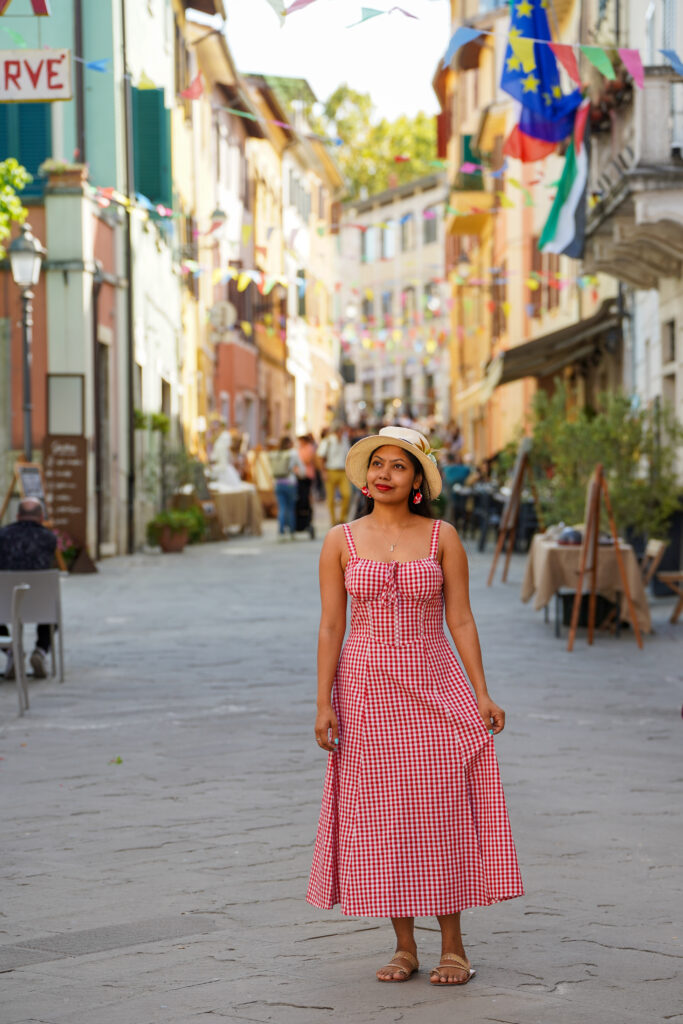
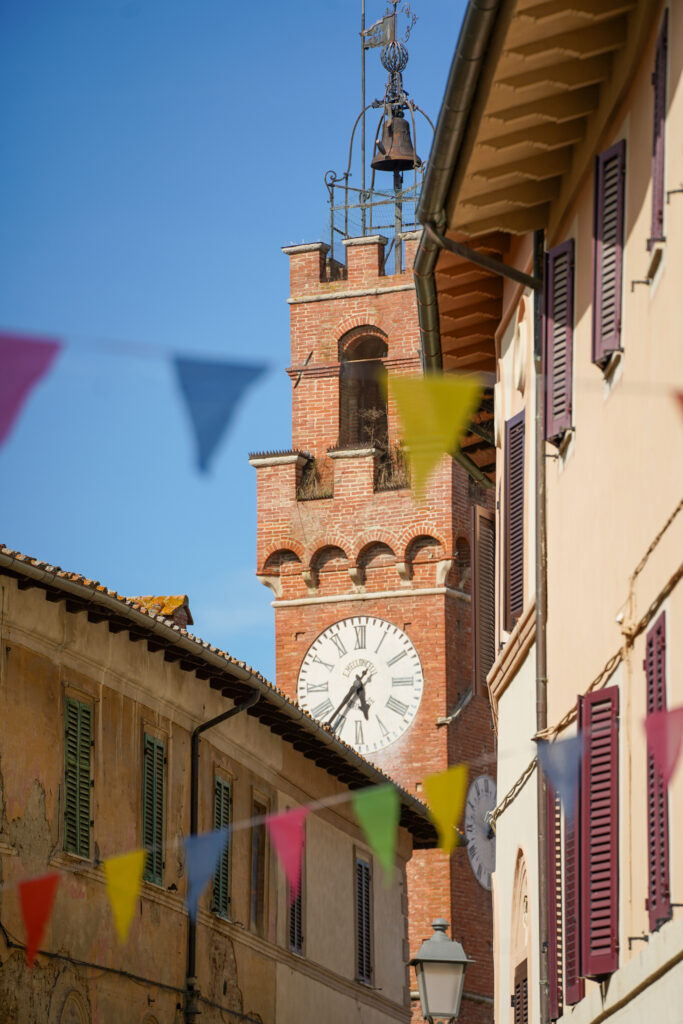
Asciano, Tuscany
Things to explore in Asciano
The town has several small museums and galleries worth poking into if you have time. The Abbey of Monte Oliveto Maggiore is nearby – a stunning monastic complex hidden in the woods. If you visit in September, there’s the “Palio dei Ciuchi” – a unique local event where districts race each other on donkeys instead of horses (yes, really).
But honestly? The best thing to do in Asciano is exactly what we did: walk the narrow streets without a plan, find a small cafe tucked into an alley, and sit with coffee watching the light change. It’s the kind of town that rewards wandering rather than checking off boxes.
Parking tip: Park at the edge of town and walk in. The center isn’t designed for cars, and navigating the narrow streets with a rental is more stress than it’s worth.
Monteriggioni: Tuscany’s Medieval Crown
Monteriggioni sits atop a hill surrounded by perfectly preserved medieval walls and fourteen watchtowers. Seen from a distance, it almost looks like a stone crown resting on the Tuscan countryside.
Paid parking is available just outside Monteriggioni’s walls. Arrive earlier during the summer, when the lots can fill quickly, and walk into the historic centre from there.
The town itself is small, but that’s part of its charm. We wandered through the narrow streets, explored the central piazza, and enjoyed lunch inside the medieval walls.
If you’re looking for somewhere to eat, Ristorante Le Torri is a great option for traditional Tuscan dishes like wild boar pappardelle and Florentine steak.
For drone photographers, Monteriggioni might be one of the most rewarding aerial locations in Tuscany. From above, the circular walls and towers create a scene that feels straight out of a fantasy film.
The aerial view is absolutely epic – those perfectly preserved circular medieval walls with 14 towers sitting on top of a hill look like something out of a fantasy movie. You’ll get the full crown effect that’s impossible to capture from ground level. This is one of those shots that will be the highlight of your camera roll. The symmetry, the walls, the way it sits on that hill – it’s drone photography gold.
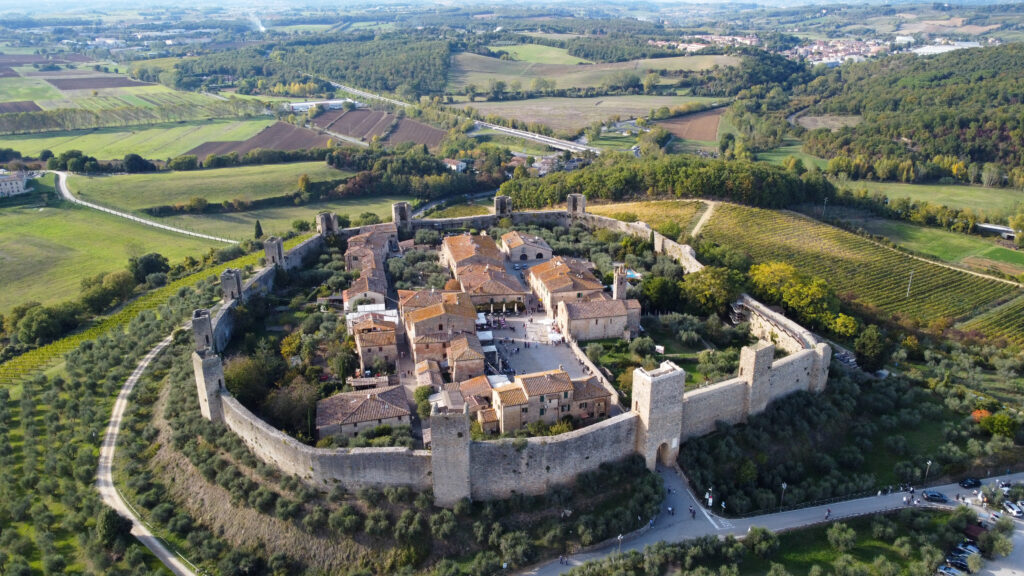
Monteriggioni Tuscany
Restaurants for Lunch
Ristorante Le Torri – Right on the main piazza, serving classic Tuscan dishes. Known for Florentina steak, pappardelle with wild boar (cinghiale), and ribollita soup. The setting in the medieval square makes the meal feel special.
Il Pozzo – Another solid choice inside the walls for traditional Tuscan fare. Locals eat here, which is always a good sign.
Bar dell’Orso – Just outside the walls, more casual and affordable. Great for a quick, authentic meal if you don’t need fancy ambiance. Good portions, solid food.
Pro tip: If you visit during the Medieval Festival in July, the town transforms completely – torches replace electric lights, and you eat with medieval currency in period taverns. It’s atmospheric but crowded.
Podere Poggio: The Golden Hour Closer
Go in the evening. Seriously, don’t show up mid-day.
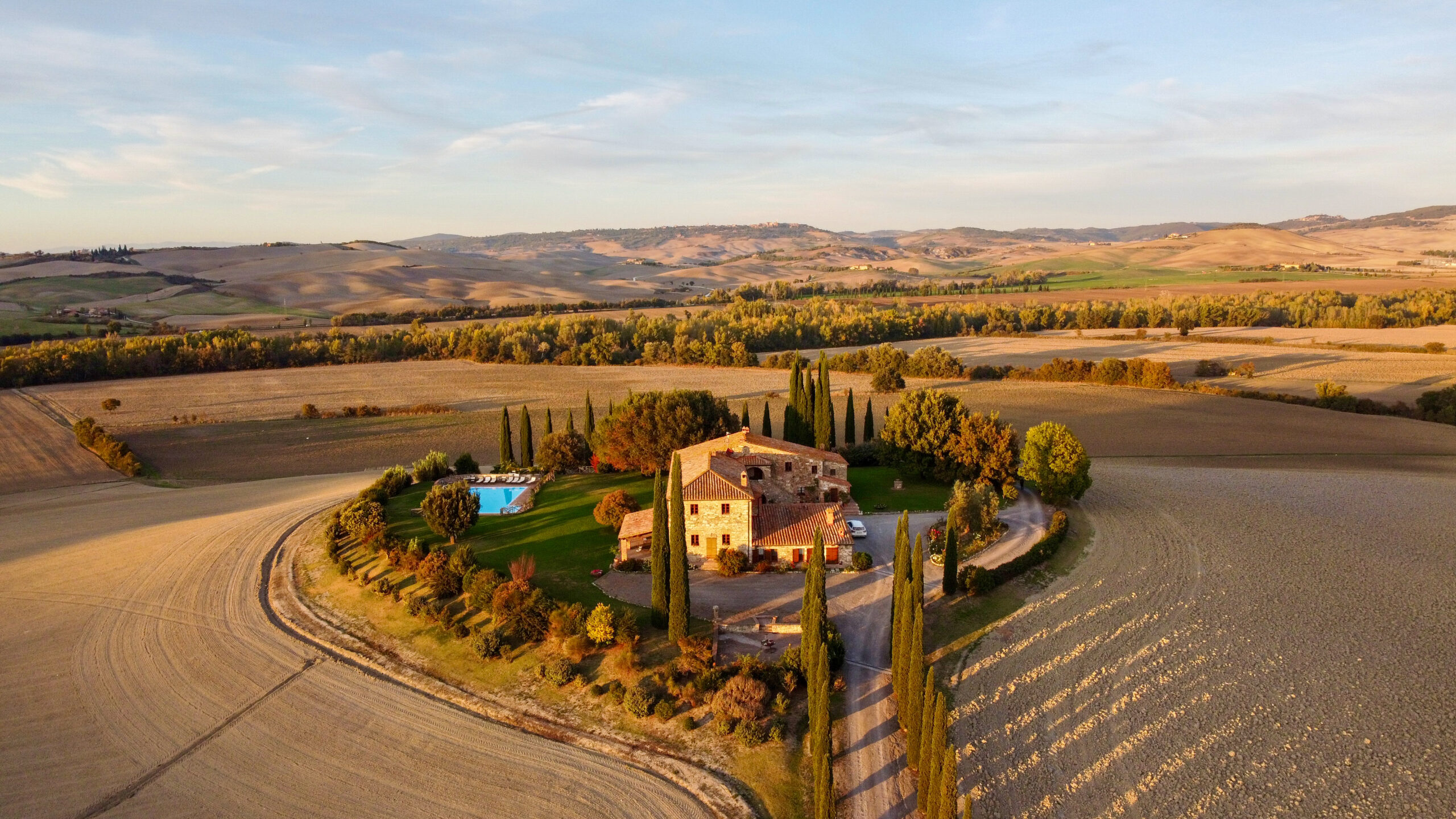
When that soft golden light hit the house and pool at Podere Poggio, it looked unreal. Like someone had Photoshopped the whole scene. The warm glow, the cypress trees, the stone glowing honey-colored in the sunset – this is what you came to Tuscany for. We ended Day here, and honestly, it was the perfect way to close out our introduction to Val d’Orcia.
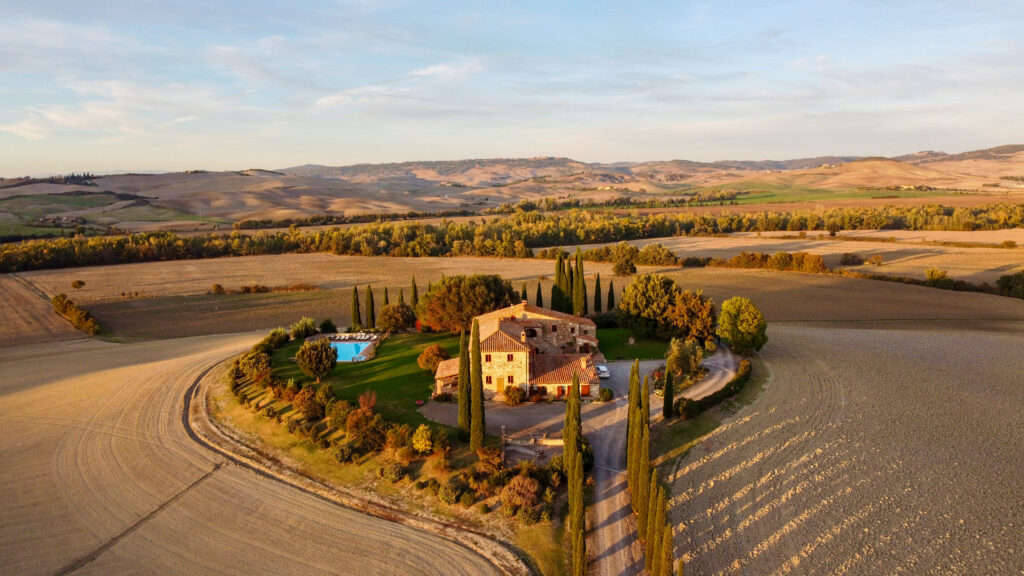
Podere Poggio, Tuscany
Day 3: Pienza: The Perfect Town (And Stroller-Approved)
We hit Pienza in the morning, and here’s something I wasn’t expecting: it’s actually easy to navigate with a stroller. Most Tuscan hill towns have you hauling gear up steep streets and stairs, but Pienza is mostly level. Smooth walkways, gentle slopes, no wrestling with cobblestones every five steps.
The town itself is small but striking. Back in the 1400s, a Pope who was born here decided to redesign the whole place as his vision of an ideal city – symmetrical buildings, a central square, everything proportioned just so. Walking through it, you can see what he was going for. It all lines up in this very intentional, harmonious way.
The best part? Walk to the edge of town where the walls overlook Val d’Orcia. The valley spreads out below – rolling hills, cypress trees, that classic Tuscan view.
Plus, the town is famous for pecorino cheese. Every shop sells it in different ages and flavors. Grab some, find a bench along the walls, and enjoy one of the best views in Tuscany while taking in the rolling hills of Val d’Orcia.
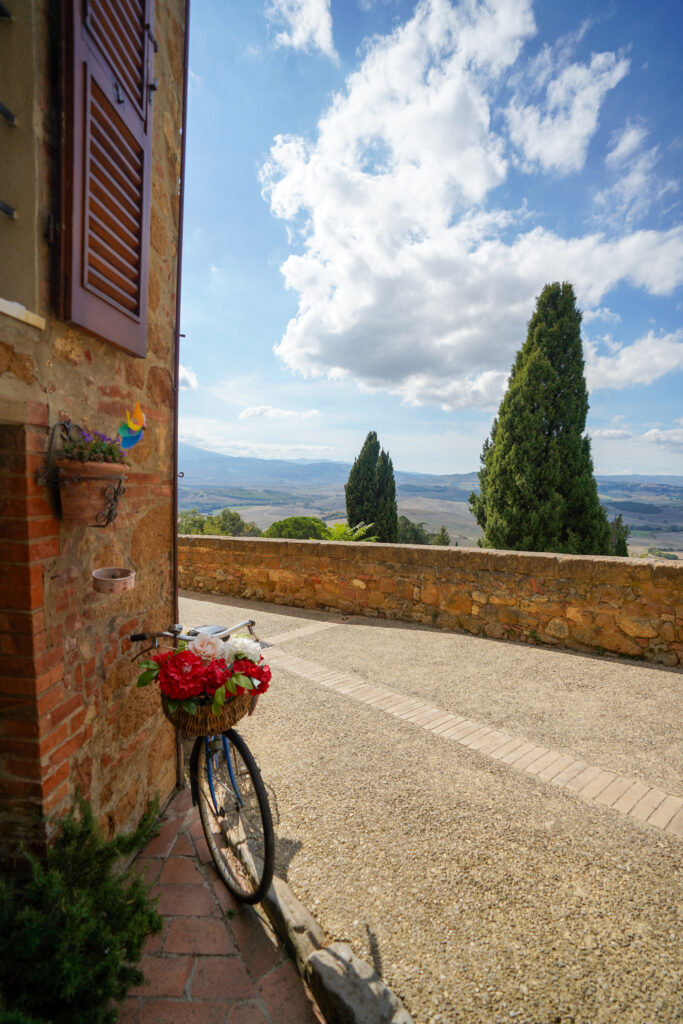
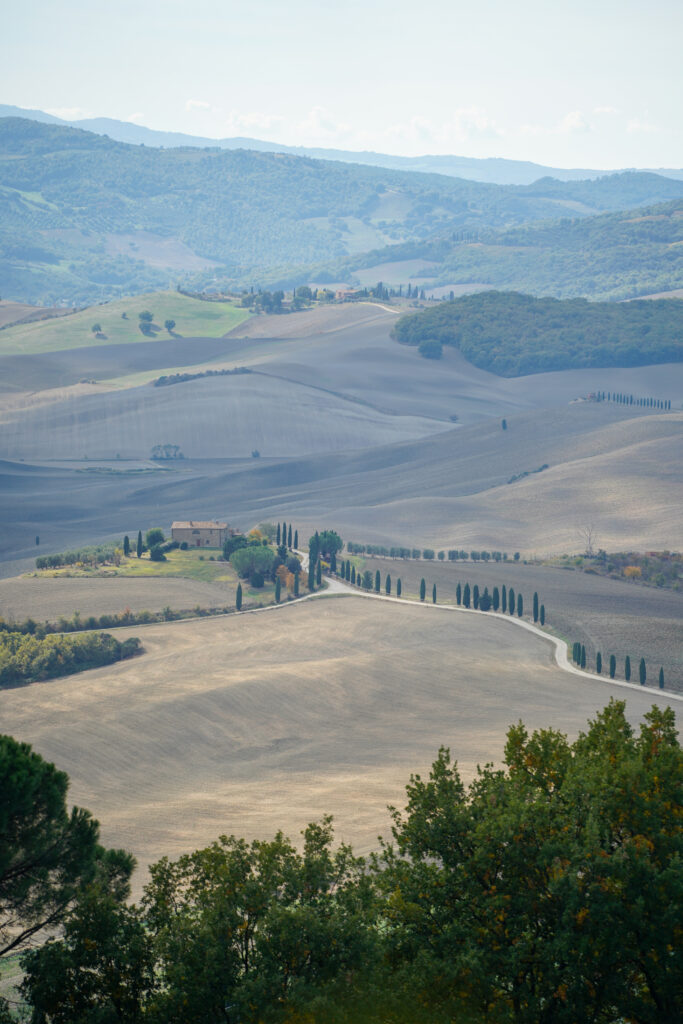
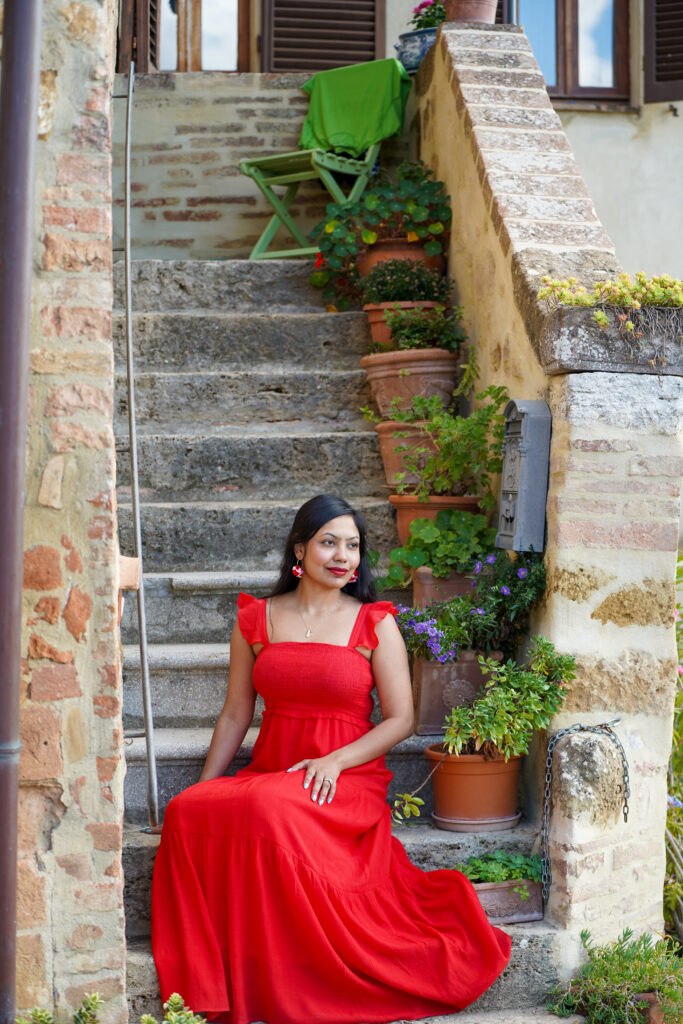
Pienza – The Most Picturesque Town in Tuscany
Pitigliano: “Little Jerusalem” Carved in Stone
The drive from Pienza takes about 1 hour 15 minutes, winding south through Tuscany’s less-traveled Maremma region.
Then Pitigliano appears, and it stops you cold.
The entire medieval village sits atop a cliff of golden volcanic tuff, with houses that seem to grow directly out of the rock face. The buildings and the stone plateau merge so completely that it’s hard to tell where nature ends and architecture begins. When the evening sun hits, everything glows warm amber – the effect is almost dreamlike.
What gives Pitigliano real depth is its nickname: “Little Jerusalem.” Centuries ago, Jewish families fleeing persecution found refuge here, and the community flourished. Today, the Jewish Quarter tells that story through spaces carved deep into the soft tuff rock.
Walking through the underground passages, you discover the 16th-century synagogue, the ritual bath where purification ceremonies took place, the cellar that stored kosher wine, and the bakery oven that produced unleavened bread. Every space is preserved, and the town clearly honors this multicultural heritage as central to its identity.
The Medici Aqueduct cuts an elegant line across the skyline, and adventurous types can explore the Vie Cave – those ancient Etruscan pathways carved impossibly deep into solid rock, connecting settlements from thousands of years ago.
Pitigliano feels like layers of history stacked on top of each other, all perched on the edge of a cliff.
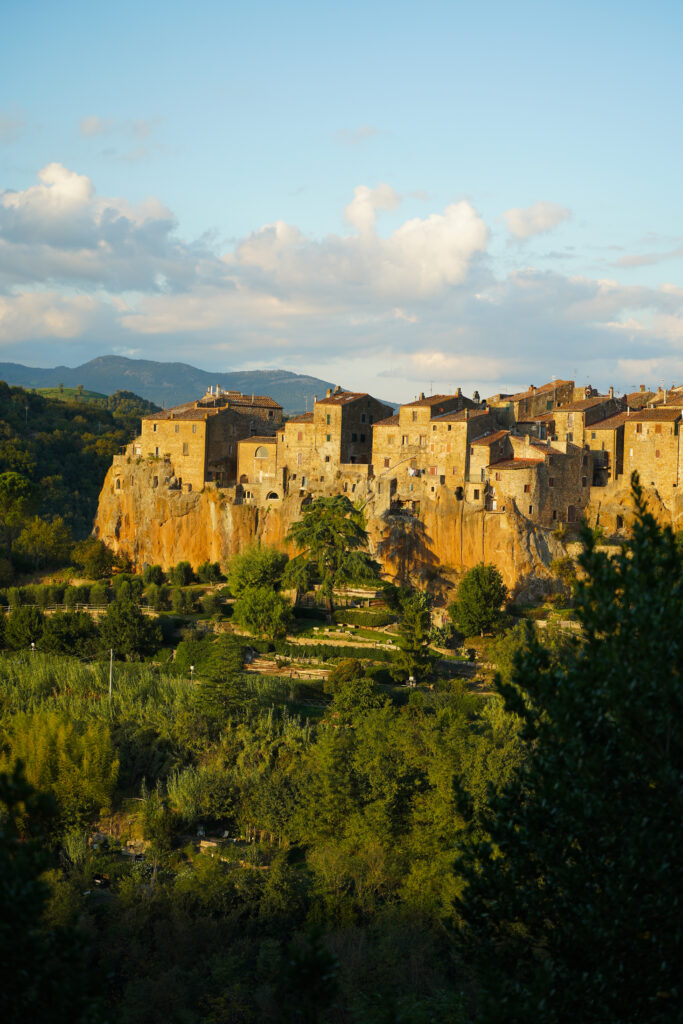
Pitigliano Tuscany
Saturnia Hot Springs: Nature’s Free Spa
Thermal water flows up from underground at a constant 37.5°C, cascading down natural stone terraces and filling bright turquoise pools. And here’s the best part: completely free access. No gates, no tickets, no schedule. Just show up and get in.
What you need to know:
- Cost: The springs are free; parking nearby costs a few euros
- When to go: Early morning or late afternoon work best – midday brings heavy crowds. Sunrise is spectacular, with steam rising off the warm water into cool air.
- What to bring: Swimsuit, water shoes (the rocky bottom gets slippery), and a towel
- Important: Remove all jewelry before entering – the sulfur and minerals in the water will permanently tarnish it
What happened to us: We arrived in the evening ready to soak, only to find a full movie production in progress. Crew, equipment, lighting rigs – they were filming until 4 AM. Not the outcome we were hoping for.
But we could still see the hot springs from above, and honestly? The view from up there was stunning in its own way. We visited in October, and the golden autumn light hit the fall colors surrounding the pools while that unreal blue water cascaded down the terraces. It looked like someone had painted the whole scene. Standing there looking down, I kept thinking: how does this amazing place even exist in the middle of nowhere?
Saturnia sits just 2 hours from Rome, making it easy to work into almost any Italy itinerary. Next time we visit, this goes first on the list – arrive at dawn before the crowds, when the pools are quiet and we can actually get in.
If you’re planning to visit, maybe call ahead or check online to confirm access. And definitely aim for those golden hours at the edges of the day when fewer people are around.
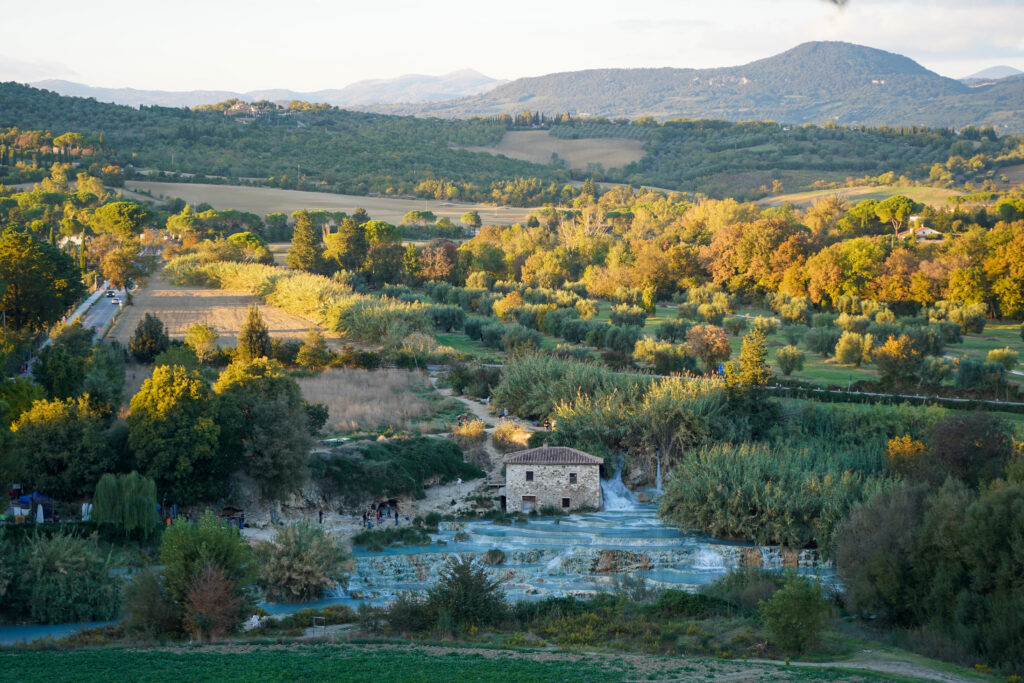
Saturnia Hot Springs, Tuscany
Strategic Stop: Overnight in Rome
From Saturnia, our next destination was Positano on the Amalfi Coast. The drive from Saturnia/Rome area to Positano is about 5-6 hours total – doable in one shot, but not ideal after a full day.
So we spent the night in Rome. Book your hotel here.
This was the right call. We relaxed, had a proper dinner, got a good night’s sleep, and started fresh the next morning for the drive south to Positano. Trying to push through after a long day would have been exhausting, and the drive into the Amalfi Coast deserves your full attention (those roads are winding and intense).
Bottom line: If you’re doing Tuscany to Amalfi Coast, build in a Rome overnight. It breaks up the journey, lets you reset, and sets you up for a much better arrival in Positano.
Day 4: Positano and Casa Cinque – The View We’d Been Dreaming Of
We checked into Casa Cinque, and the moment we stepped onto our balcony, I understood why we’d booked this specific place. The view was everything. Check rates for Casa Cinque in Positano here.
Positano spread out in front of us – pastel houses stacked into the cliffside, tumbling toward the beach, with the Mediterranean glittering beyond. It was the exact view I’d seen in travel magazines since I was a kid, the image that made Positano famous. And now we were looking at it from our own balcony.
Casa Cinque also offered covered parking right beside the property for an additional €20 per day, which made arriving by car much easier – a huge relief in a town where parking is notoriously difficult.
And the beach? Spiaggia Grande, Positano’s main beach, is roughly a 7–10-minute downhill walk from the hotel. The return walk may take closer to 10–15 minutes because it is uphill and involves several steps.
Planning to spend a full day here? Read my complete one-day Positano itinerary for transportation advice, viewpoints, beaches, restaurants and practical tips.
Navigating Positano with a Baby: Stairs, Not Strollers
Positano is built on a cliff, which means one thing: stairs. Lots of them.
Our host was direct about it – don’t bring the stroller. The roads are narrow, traffic flows constantly in both directions, and the constant steps make pushing anything wheeled more trouble than it’s worth. We took their advice, put our son in a carrier, and he stayed comfortable the whole time while we had our hands free to navigate.
The Walk Down: Art, Lemons, and a Church with a Glowing Dome
Walking down toward the beach, Positano reveals itself in layers. Little art galleries tucked into storefronts, paintings of the coast propped against doorways. Gelato shops every few steps, many featuring the famous lemon flavor – Positano lemons are huge, fragrant, and used in everything from gelato to limoncello.
Then we passed the Church of Santa Maria Assunta, sitting right in the heart of town near the beach. You can’t miss it – the dome is covered in bright yellow, green, and blue majolica tiles that catch the sun. It’s one of those images that defines Positano as much as the stacked houses themselves. Small, beautiful, right there in the middle of the action.
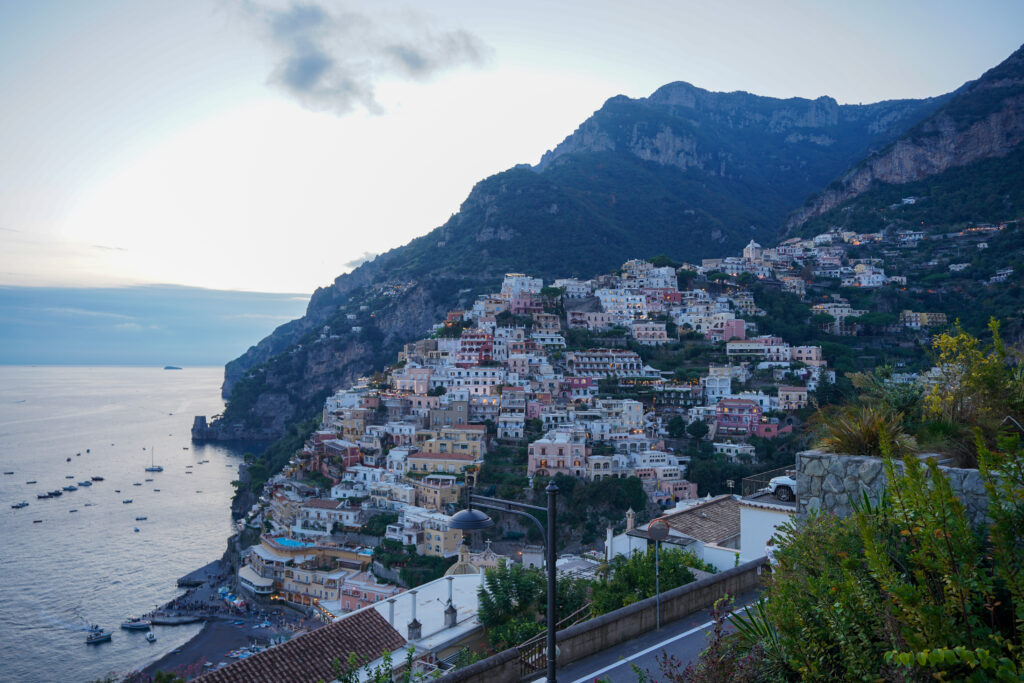
Postcard view of Positano, Amalfi Coast
October Beach Afternoon
We spent the afternoon at Spiaggia Grande, Positano’s main beach. October timing was perfect – the weather was comfortable, warm enough to enjoy being outside without the crushing summer heat. The water? Cold. But manageable if you were brave enough.
The beach isn’t huge, and it’s pebbly rather than sandy, but sitting there with the colorful town rising up behind you and the cliffs framing either side – it’s a setting that makes up for everything.
Dinner by the Beach (The Safer Choice with a Walking Baby)
After heading back to the hotel to change, we walked down again for dinner. We ate at one of the first restaurants you encounter coming down to the beach – the ones right on the waterfront with tables looking out at the water.
Here’s something worth noting: Positano has incredible restaurants perched up along the main road with gorgeous views overlooking the town. But with a baby who was walking, we made a conscious choice to eat down at beach level instead. The main road has constant traffic – cars, scooters, buses squeezing past each other on that narrow coastal route – and restaurants right beside that flow felt less safe with a toddler who could wander. Down by the beach, we had space, less chaos, and could actually relax while he moved around.
What to Eat in Positano
The Amalfi Coast is seafood territory, and Positano delivers:
Scialatielli ai Frutti di Mare – Thick, hand-cut pasta (invented right here on the Amalfi Coast) tossed with a mix of fresh seafood – mussels, clams, prawns, whatever came in that day. This is the signature dish, and for good reason.
Spaghetti alle Vongole – Simple, classic, perfect: spaghetti with fresh clams, garlic, white wine, and parsley. When the ingredients are this fresh, you don’t need anything fancier.
Lemon everything – Positano lemons are massive and intensely fragrant. Try lemon pasta (creamy risotto or tagliolini with lemon and shrimp), lemon cake (Delizia al Limone – sponge cake with lemon cream), and obviously lemon gelato.
Fresh grilled fish – Whatever the boats brought in that morning, grilled simply with olive oil and lemon.
The food here isn’t complicated. It’s about taking what the sea provides, what grows on the hillsides, and letting those flavors speak for themselves.
Day 5 – Amalfi & Ravello
Amalfi: The Coast’s Heart (And Where The Lemons Take Over)
Before heading inland to Ravello’s hilltop gardens, we stopped in Amalfi town itself – the actual heart of the Amalfi Coast. It’s easy to skip in favor of Positano, but that would be a mistake.
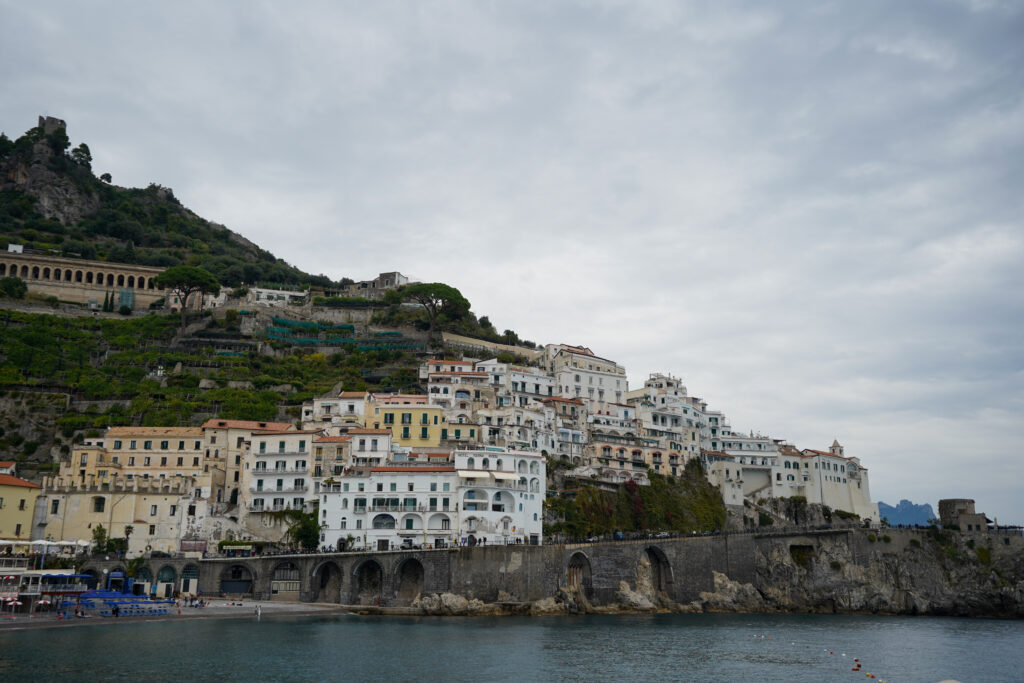
Amalfi’s pastel-coloured buildings cascading down the cliffs toward the Mediterranean Sea.
Amalfi Cathedral: The Duomo
Start with the Duomo di Sant’Andrea Apostolo, sitting right in the center of town. This isn’t just any church – it dates back to the 9th century and has this stunning Arab-Norman Romanesque style with striped marble and intricate stonework. It’s imposing without feeling cold.
Tip: Arrive early in the morning before the crowds. By mid-morning, it gets packed with tour groups, and the magic of the space gets lost in the chaos.
Lemon Sorbet in a Lemon: Non-Negotiable
Here’s the thing about the Amalfi Coast: it’s not just about the views. It’s about the Sfusato Amalfitano lemons – these massive, fragrant lemons that define the entire region. And the best way to experience them? Lemon sorbet served inside a hollowed-out lemon shell.
This isn’t a gimmick. It actually works. The cold, intensely lemony sorbet in the actual lemon peel – it’s simultaneously refreshing and quintessentially Amalfi. You’ll find these on every corner, in gelato shops and pastry shops along the main street (Ruga Nova Mercatorum).
Where to get it:
- Gelato shops along Ruga Nova Mercatorum – the main street has dozens of options. Expect to pay €7-10.
- Andrea Pansa – the oldest pastry shop in Amalfi. Try their Lemon Delight dessert too (cake soaked in limoncello, topped with lemon cream).
- Piazza dei Dogi – if you want to avoid the touristy main square crowds, look for gelato shops here. You’ll pay slightly less and the sorbet tastes just as good.
Pro tip: The lemon sorbet is Instagram-famous, so yes, there will be queues. But it’s one of those experiences that actually lives up to the hype.
Fresh Seafood: The Main Event
No trip to Amalfi is complete without trying the fresh seafood. The signature dish is Scialatielli ai Frutti di Mare – that thick, hand-cut pasta we mentioned in Positano, tossed with whatever seafood came in that morning. It’s simple, fresh, and remarkable.
Best restaurants for seafood in Amalfi town:
- Marina Grande – locals recommend this for some of the best seafood in town
- Da Maria – authentic, straightforward seafood done right
- Taverna degli Apostoli – solid choice for traditional Amalfi Coast fare
Things to Explore:
Beyond the cathedral and the lemon sorbet, wander the streets. Amalfi has small shops selling ceramics, limoncello, and local products along the main drag. The Chiostro del Paradiso (Cloister of Paradise) is worth a visit if you have time – a 13th-century cloister that’s genuinely beautiful and much quieter than the cathedral square.
Honest take: Amalfi is more tourist-oriented than some of the quieter coast towns. But that’s partly because there’s actually a lot worth experiencing here. The cathedral is genuinely impressive. The lemon sorbet is genuinely worth trying. The seafood is genuinely fresh.
Just go early, skip the restaurants with staff soliciting you outside, and embrace the fact that this town has earned its reputation for a reason.
Ravello: The Hilltop Escape from the Amalfi Chaos
Ravello sits perched on a hillside, looking down at the Amalfi Coast below like it knows something the crowded beaches don’t. It’s close enough to the coast to be part of the scene, far enough up the mountain to feel like its own world entirely.
We came here after several days of navigating the winding roads of the Amalfi Coast. The drive up to Ravello felt even more intense, with tight switchbacks, narrow mountain roads, and one curve after another. But the moment we arrived and saw the coastline from above, the journey felt completely worthwhile.
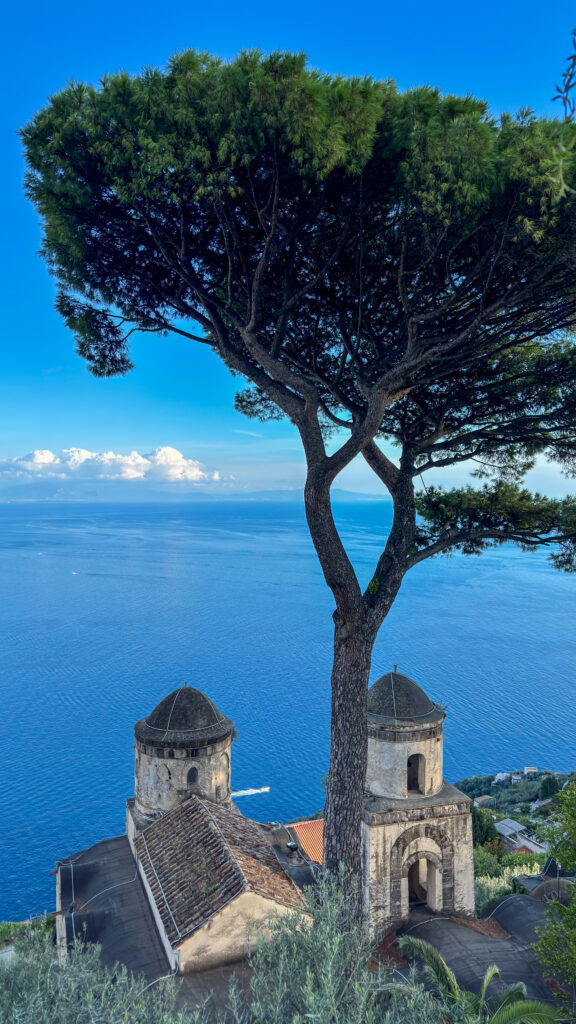
Villa Rufolo View Ravello Amalfi Coast
Villa Piedimonte: The View Worth the Drive
We stayed at Villa Piedimonte, a small hotel carved into the hillside with a few rooms and a balcony that overlooked the entire Mediterranean. Our room had its own private terrace, and the moment we stepped outside, the view stopped us in our tracks.
The view was everything. Cliffs dropping down to the coast, the sea beyond in layers of blue, the morning light hitting the water just so. I’ve seen a lot of beautiful views, but this one felt different. Personal. Like we’d found something the guidebooks didn’t know about yet.
The hotel came with breakfast, and I have to say – Italian breakfasts are a thing. Fresh pastries that tasted like someone had made them that morning (they probably had), strong coffee, fresh fruit, creamy yogurt. Simple but actually good. The kind of breakfast that sets the tone for your whole day.
Check rates and availability here.
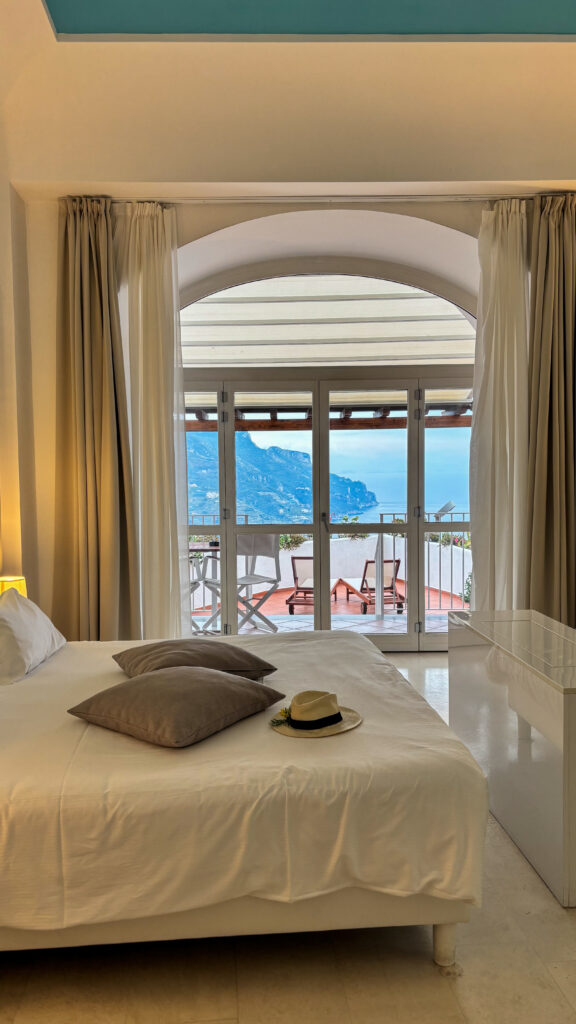
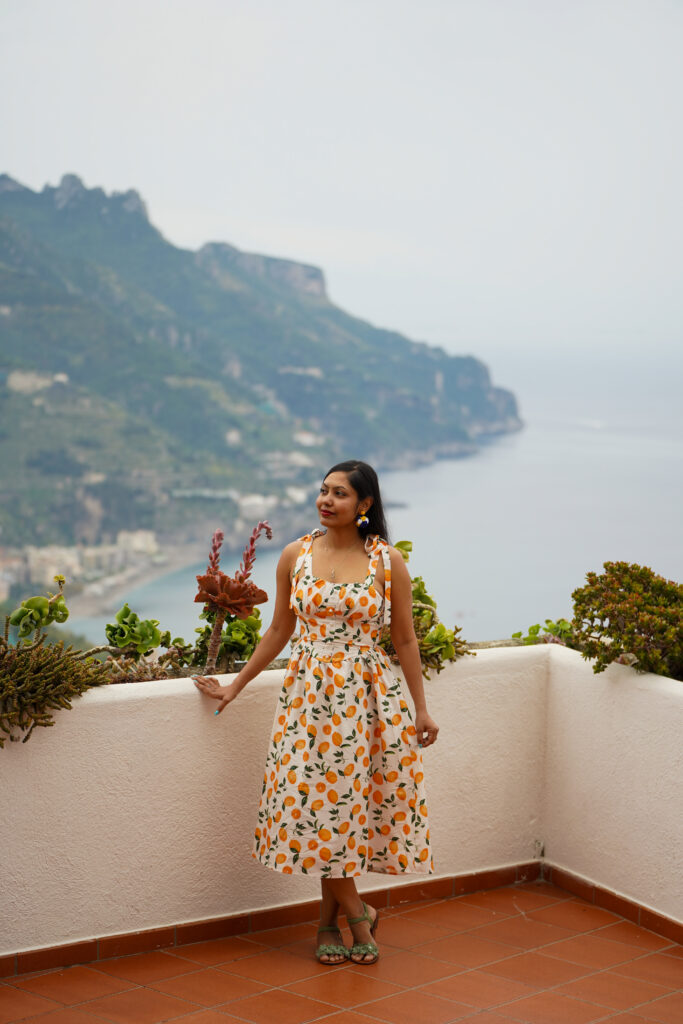
Villa Piedimonte, Ravello – Amalfi Coast
Why Ravello Feels Different
After the traffic, crowds and steep streets of Positano and Amalfi, Ravello felt like a completely different side of the coast.
The town sits high above the Mediterranean, with narrow lanes, quiet piazzas and viewpoints appearing between pastel buildings. There were still visitors, but the atmosphere felt calmer and less rushed. Instead of fighting for space near the beach, we could walk slowly, stop for coffee and enjoy the views without feeling as though we needed to keep moving.
Ravello is not where you come for swimming or nightlife. You come for gardens, history, peaceful streets and some of the most beautiful views on the Amalfi Coast..
Getting to Ravello Without a Car
We had a rental car, so we just drove up. But if you’re relying on public transport, here’s what you need to know:
From Sorrento to Ravello:
Option 1: Bus + Bus (Budget-Friendly)
- Take the SITA bus from Sorrento to Amalfi (hourly departures, about 1 hour 40 minutes, €3-5)
- Once in Amalfi, catch another SITA bus up to Ravello (runs frequently, about 30 minutes, €2-5)
- Total time: Roughly 2.5 hours with waiting time
- Total cost: Around €6-10
- Reality check: The buses generally run on schedule, but coastal traffic can cause significant delays, especially during summer.
Option 2: Ferry + Bus (Scenic)
- Ferry from Sorrento to Amalfi (twice daily, about 1 hour 20 minutes, €16-35)
- Same SITA bus from Amalfi up to Ravello (30 minutes, €2-5)
- Total time: About 2 hours if timings align
- Total cost: Around €20-40
- Why choose this: You get to experience the coastline from the water, which is genuinely beautiful. The ferry adds time but removes driving stress.
Option 3: Private Transfer
- Companies like Daytrip offer private car service from Sorrento to Ravello for around €29-60 per person
- They handle all the driving and logistics
- Takes about 1.5-2 hours depending on traffic
- Worth it if you have 2+ people and don’t want to navigate buses
From Amalfi to Ravello:
This is the most straightforward connection since Amalfi is on the coast and Ravello is literally just up the hill.
SITA Bus:
- Direct bus from Amalfi to Ravello (Line 5110)
- Runs frequently, especially in summer (buses every 30 minutes)
- Takes about 30 minutes
- Cost: €2-5
- Buy tickets at bars, tobacco shops (Tabaccheria), or train stations – NOT on the bus
Taxi:
- If you’re frustrated with buses, taxis are available at the Amalfi port
- More expensive but direct
- Rough estimate: €30-50 depending on negotiation
Tips for Public Transport:
- Start early. Buses fill up and schedules get disrupted by coastal traffic
- In summer (June-August), buses are more frequent but more crowded
- Buy your ticket BEFORE boarding – you can’t buy on the bus
- The roads are winding. If you’re prone to motion sickness, sit near the front and look at the horizon, not your phone
Before you go, check the latest ferry and bus schedules, as departure times can change seasonally and are often affected by weather conditions. If you prefer a hassle-free journey, you can also book transfers and activities in advance through Klook.
➡ Check the latest ferry schedules with Travelmar
➡ Browse Amalfi Coast tours and transfers on Klook
The Gardens of Ravello
Ravello is best known for two historic villas: Villa Rufolo and Villa Cimbrone. We visited Villa Rufolo, so the details below are based on our own experience there.
Villa Rufolo Gardens
Villa Rufolo is located close to Ravello’s main square, making it very easy to include while exploring the town on foot.
The villa dates back to the 13th century and combines historic architecture, courtyards, towers and beautifully maintained gardens. Stone pathways lead through colourful planting areas and terraces positioned above the Amalfi Coast.
The famous garden terrace was the highlight for us. From there, the Mediterranean stretches out below, framed by umbrella pines, flowers and the towers of the Church of the Annunziata. The entire setting feels carefully designed around the landscape, with each level revealing another perspective over the coast.
German composer Richard Wagner visited Villa Rufolo in the 19th century and was famously inspired by its gardens. Standing there with the sea below, it is easy to understand why.
Allow around one to two hours, depending on how slowly you want to explore and take photographs. Wear comfortable shoes because the villa includes steps, pathways and different levels..
Practical tip: The gardens involve walking up and down levels and some uneven paths. Comfortable shoes are essential. Plan for 1.5-2 hours if you want to actually absorb it instead of rushing through for photos.
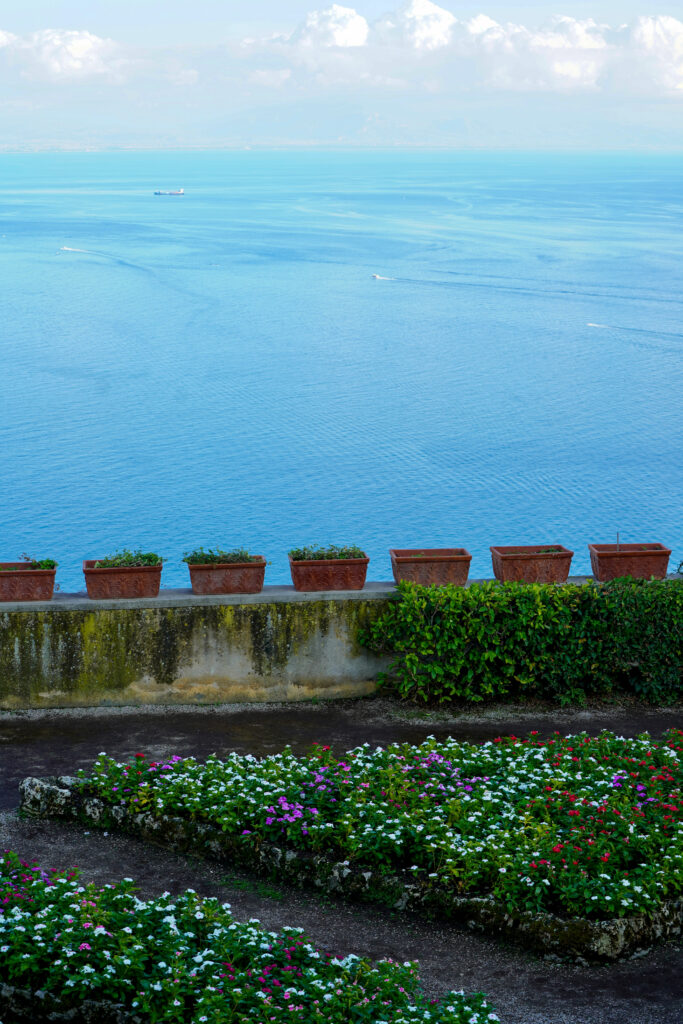
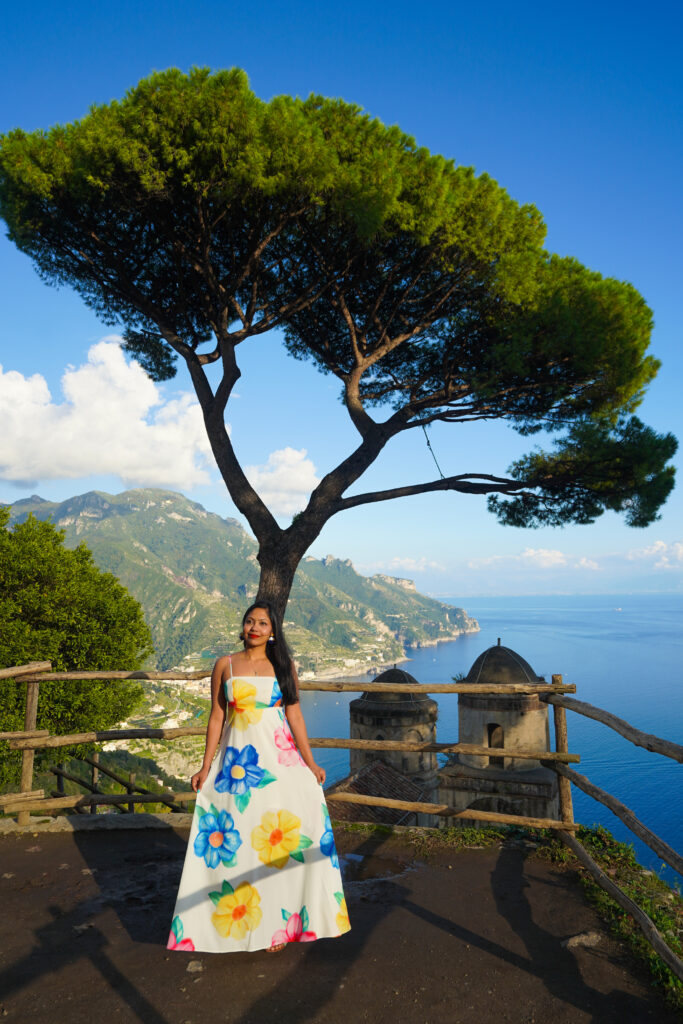
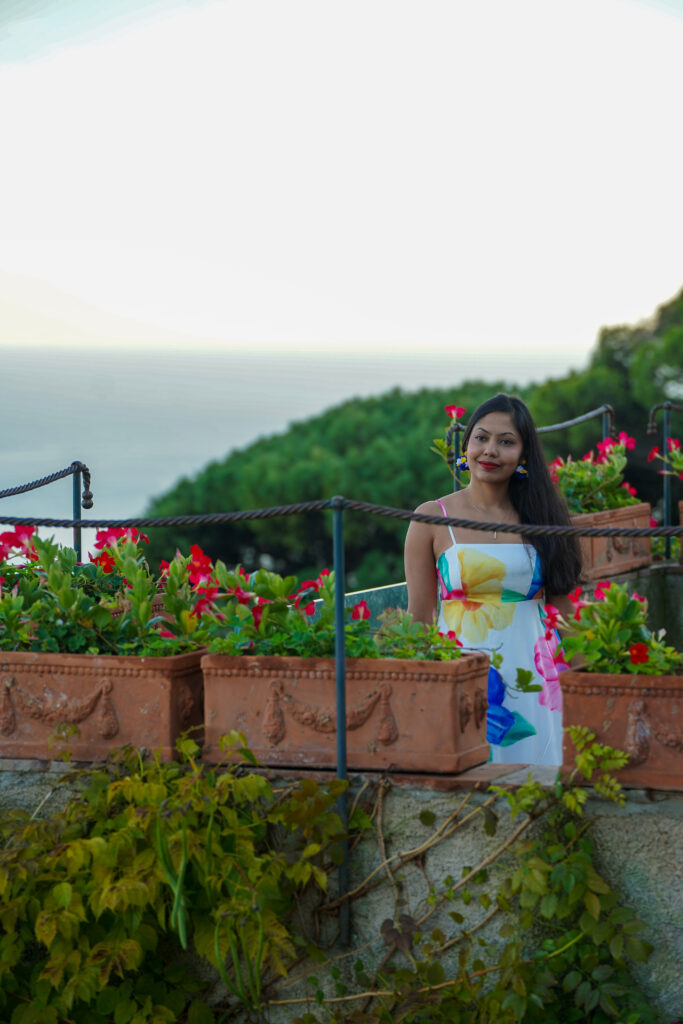
Villa Rufolo Gardens Overlooking Amalfi Coast
Villa Cimbrone Gardens: Another Option
We did not visit Villa Cimbrone on this trip, but it is another highly regarded garden in Ravello and is best known for the Terrace of Infinity, a dramatic viewpoint lined with marble busts overlooking the Mediterranean.
If you only have limited time, choose the villa that appeals to you most. Villa Rufolo is closer to Ravello’s central square and worked perfectly with our schedule. If you have a full day, visiting both would give you two different perspectives of the town and coastline.
Beyond the Gardens
After Villa Rufolo, spend some time wandering through Ravello’s centre. Piazza Vescovado, the Duomo and the small ceramic shops are all within easy walking distance.
But the part we enjoyed most was simply walking without a strict plan. Ravello constantly reveals small terraces, quiet corners and unexpected views between its buildings.
For us, Ravello was the place where the Amalfi Coast finally slowed down. It gave us the scenery we came for without the same intensity as the towns below – and after several busy days, that was exactly what we needed.
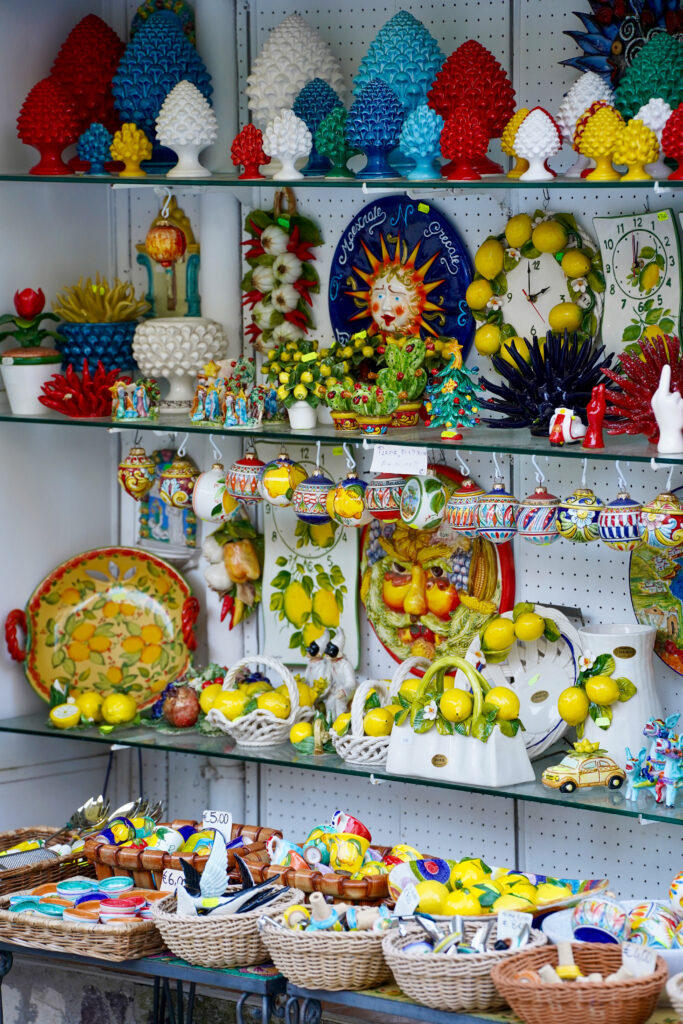
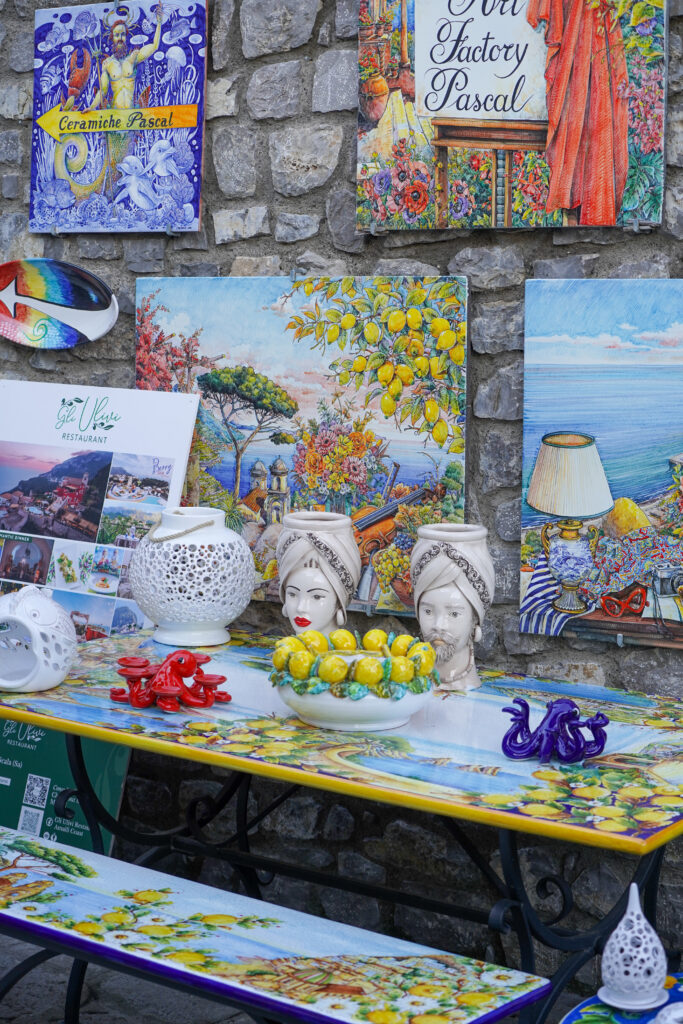
Colorful Ravello Ceramic Shop – Italy
Why Ravello Over the Beach Towns
You’re not coming here for swimming or beach time. You’re coming here because you want to slow down. You want views that make you stop scrolling through your phone. You want to walk to breakfast without navigating crowds.
It’s hillside Italy at its most romantic – the kind of place where you understand why people write novels about getting lost in small Italian villages.
If you’ve been overwhelmed by Positano or Amalfi, or if you just want something quieter on the Amalfi Coast, Ravello is the answer. It’s close enough to explore the coast but far enough away to actually breathe.
Day 6 & 7-Alberobello: The Fairytale Town of Cone-Roofed Houses
Drive from Ravello: Approximately 3 hours 41 minutes (about 320km)
We left the clifftop beauty of Ravello and headed south into Puglia, toward a town that looks like it was constructed from someone’s imagination. Alberobello doesn’t feel real at first – the houses are too charming, the streets too narrow, the whole scene too perfectly arranged to actually exist.
But it does. And we spent two days getting lost in its magic.
Where We Stayed: Two Authentic Trulli Experiences (Highly Recommended)
We stayed in two different trulli during our time in Alberobello, and both were genuinely dreamy in their own way.
Monte Adamello – Dimora Bro Trulli
Our first stay was at Monte Adamello – Dimora Bro Trulli, a small property within Alberobello’s historic trulli area. It was only a three-to-four-minute walk from the parking area, which made arriving with our luggage surprisingly easy while still allowing us to stay among the traditional cone-roofed homes.
The trullo itself was everything we had hoped for—ancient stone walls, a distinctive conical roof and the feeling that we had stepped inside a living piece of history. The moment we walked outside, we were surrounded by Alberobello’s narrow streets, local shops and clusters of whitewashed trulli. There was no need to drive anywhere; we could simply leave the car parked and explore on foot.
Trulli Antichi Mestieri
We also stayed at Trulli Antichi Mestieri, a collection of traditional trulli spread throughout Alberobello’s historic centre. Our accommodation consisted of several connected trulli, creating a charming little compound with more character than a conventional hotel room.
The location was one of its biggest advantages. We were right within the historic trulli district, with restaurants, shops and Alberobello’s main sights only a short walk away. Despite being so central, stepping inside still felt peaceful and private – a welcome contrast to the lively streets outside.
The interior retained the character of the original structure while still providing the comfort we needed for our stay. Sleeping beneath the curved stone ceiling and waking up inside one of Alberobello’s iconic buildings made the experience feel far more memorable than staying in a standard hotel.
If you’re visiting Alberobello, I highly recommend prioritizing at least one night in an authentic trullo. You aren’t simply looking at the architecture from the outside – you get to sleep beneath the cone-shaped roof, understand how the space feels and briefly experience a part of the town’s history for yourself.
Parking tip: Most of Alberobello’s historic trulli streets are pedestrianized or best explored on foot. We parked near the entrance to the historic district and walked to our accommodations. Once the car was parked, we did not need it again during our stay.
The Hidden History: Why Trulli Were Built the Way They Were
While we were wandering the streets, a local shared something interesting: the reason trulli were constructed the way they were – with those removable stone roofs and minimal mortar – wasn’t just about practicality.
They were built this way partly to avoid taxes. When tax collectors came around, residents would disassemble the roofs and knock down sections of the walls. Once the taxman left, they’d rebuild everything. Since the structures were technically “incomplete,” they didn’t count as permanent dwellings subject to taxation.
Whether this is folklore or actual history, it adds another layer to understanding why these buildings look and function the way they do. They weren’t just charming – they were clever survival structures.
What Are Trulli (And Why Alberobello Has So Many)
A trullo is a round stone dwelling topped with a cone-shaped roof made of limestone tiles. Over centuries, they became permanent homes, and Alberobello developed the densest concentration of them anywhere in Italy.
Walking through Alberobello, you’re surrounded by hundreds of these structures stacked on hillsides, their conical roofs rising like a forest of stone mushrooms. It’s surreal and beautiful and slightly overwhelming all at once.
The Early Morning Magic: Why 7 AM Matters
We woke at 7am with one goal: photograph the town before it woke up.
This is where Alberobello reveals itself at its best. The streets were empty. No tour groups. No crowds. Just us, the narrow alleyways, and the early light hitting those cone roofs.
The difference between 7am Alberobello and 10am Alberobello is extraordinary. By mid-morning, bus tours arrive in waves, souvenir shops fill with people, and the streets become navigating obstacle courses. But at dawn? The town belongs to you.
We wandered for two hours in that quiet golden light, turning corners that opened into tiny piazzas, climbing staircases that connected different levels of the town, discovering angles and views that felt like we’d found something secret.
Real talk: If you’re going to Alberobello, staying overnight is non-negotiable. You need those early morning hours when the town is still sleeping.
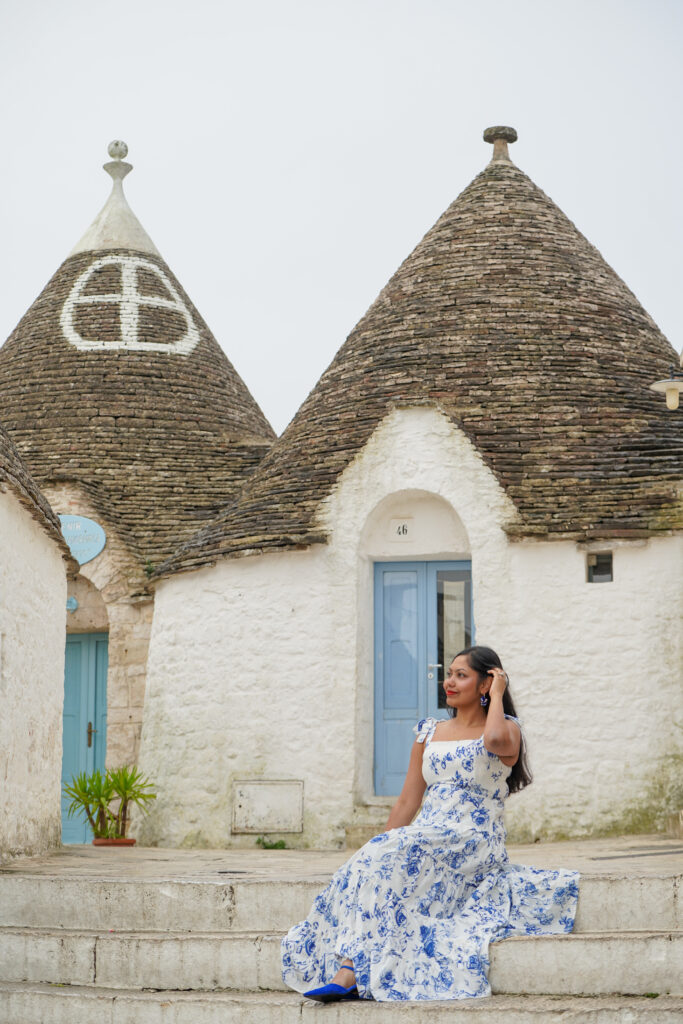
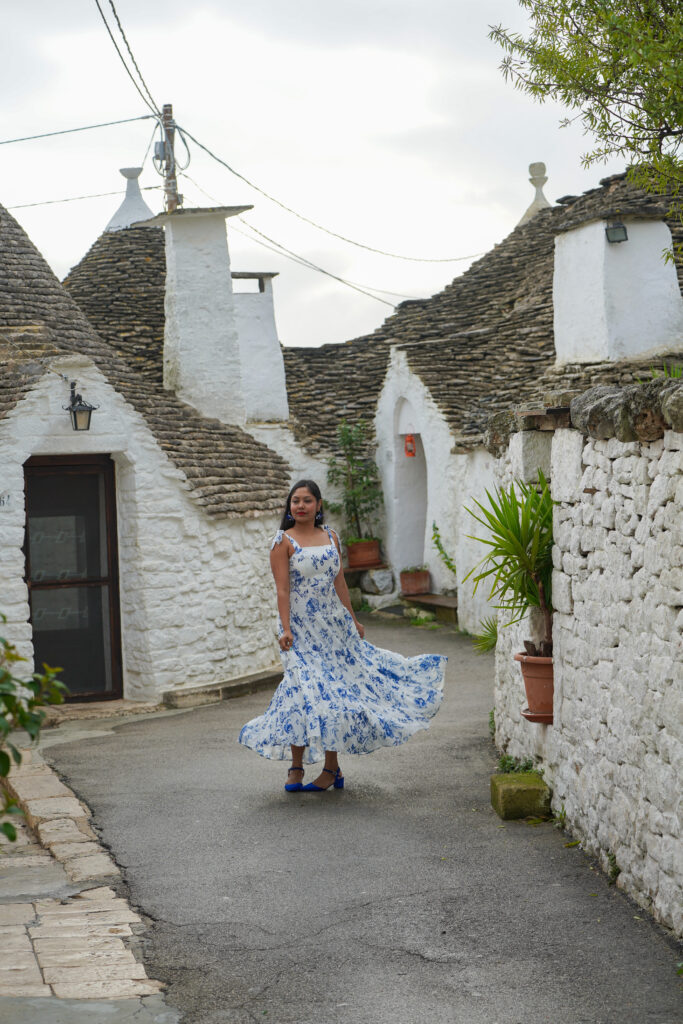
Wandering Through the Magic of Alberobello
Things to Do in Alberobello
1. Wander (Seriously, Just Wander)
The best thing to do in Alberobello is move through it without a plan. Turn down narrow streets. Follow staircases. Let yourself get slightly lost. The town is small enough that you won’t actually get lost, but the wandering is the point.
You’ll find:
- Tiny piazzas with cafes tucked into trulli
- Steep staircases connecting different levels
- Doorways opening onto unexpected views
- Windows decorated with flowers
- Laundry hanging between buildings (especially in the quieter Rione Aia Piccola section)
2. Explore Rione Monti (The Main Tourist Area)
This is the primary trulli district – over a thousand trulli line the winding streets. Yes, it’s touristy. Yes, there are souvenir shops selling the same postcards and magnet replicas. But the architecture itself is genuine and worth exploring.
The streets here are built on a hillside, so you’re constantly climbing up or down, which means constantly getting new views and perspectives. Even with crowds, the physical layout of the town makes exploration feel fresh.
3. Discover Rione Aia Piccola (The Quieter Side)
This smaller trulli district is where locals still live. It’s less commercialized, quieter, more intimate. Walking here, you get a sense of what Alberobello was like before tourism took over.
The narrow streets are even narrower. You see actual daily life – people chatting on doorsteps, laundry hanging, children playing. It feels like stepping back in time in a way Rione Monti doesn’t quite capture.
Important: This area is residential. Keep your voice down and be respectful when taking photos. You’re walking through people’s homes.
4. Visit Trullo Sovrano
This is the only two-story trullo in all of Alberobello – a rare luxury structure built for a wealthy 18th-century priest. Today it’s a house museum where you can see how people actually lived inside these cone-shaped homes.
The rooms are small. The furnishings are period-authentic. You get a real sense of the scale and daily life within these buildings. It’s only about €2-3 entry and takes maybe 30 minutes to walk through, but it adds context to everything you’ve seen.
5. The Trullo Siamese
This famous trullo has a twin-cone design (two cones instead of one) – the only one of its kind. According to local legend, two brothers fell in love with the same woman, so the trullo was divided into two separate living spaces. True or not, it’s visually unique and worth seeing.
It’s now a souvenir shop, so you’ll encounter the tourist side of Alberobello, but the architecture itself is genuinely interesting.
6. Visit the Trullo Church
Chiesa a Trullo (the Trullo Church) was built in 1927 with traditional trullo architecture – a large central cone-shaped roof with smaller conical domes. It’s small, charming, and unique. Quick stop but worth it.
7. Eat a Pasqualino
In 1966, a local shop owner invented Alberobello’s signature sandwich: rosetta bread filled with tuna fish, capers, salami, and cheese, in that exact order. It’s called the Pasqualino.
It sounds questionable (tuna and salami?) but it’s a local tradition. If you eat meat, try one. If you’re vegetarian, the town has other options, but this is the iconic Alberobello experience.
8. Shop (Thoughtfully)
The main streets are lined with shops selling ceramics, olive wood carvings, woven textiles, and local products. Most souvenir shops are repetitive, but if you wander, you’ll find artisans making actual quality goods. Look for handmade ceramics and carved olive wood items – things with real craftsmanship behind them.
The Best Photo Spots in Alberobello
Villa Comunale Belvedere Parco
A small tree-lined park with benches and the most iconic view over Rione Monti. Hundreds of conical roofs spread out below you like stone mushrooms. This is where you get THE photo of Alberobello.
Pro tip: Go early morning for soft light and no crowds. Sunset also works beautifully but expect company.
Belvedere Santa Lucia
Another elevated viewpoint with a similar panoramic perspective. This one tends to be slightly less crowded than Villa Comunale, making it good for a second angle or a quieter moment.
Via Monte San Michele
The main shopping street lined with souvenir shops and decorated trulli. Visually, it’s one of the most photogenic areas – colorful doorways, flowers, winding streets.
Romantic Trulli Hotel
This famous accommodation has pink flowers outside and is photographed constantly. If you’re not staying here, you’ll definitely see people lined up taking photos of it. It’s Instagram famous for a reason – the pink flowers against the stone create a beautiful color contrast.
Rooftop Terraces in Souvenir Shops
Look for signs saying “terrazza panoramica” (panoramic terrace). Buy something small from the shop – literally anything – and you get access to their rooftop terrace with views across the trulli. This is a clever local hack that gives you elevated views without paying separate viewpoint fees.
The Streets Themselves
Honestly, the entire town is photogenic. Narrow alleyways, unexpected corners, staircases, doorways, flowers, light hitting cone roofs – you don’t need a “spot.” Just walk and shoot.
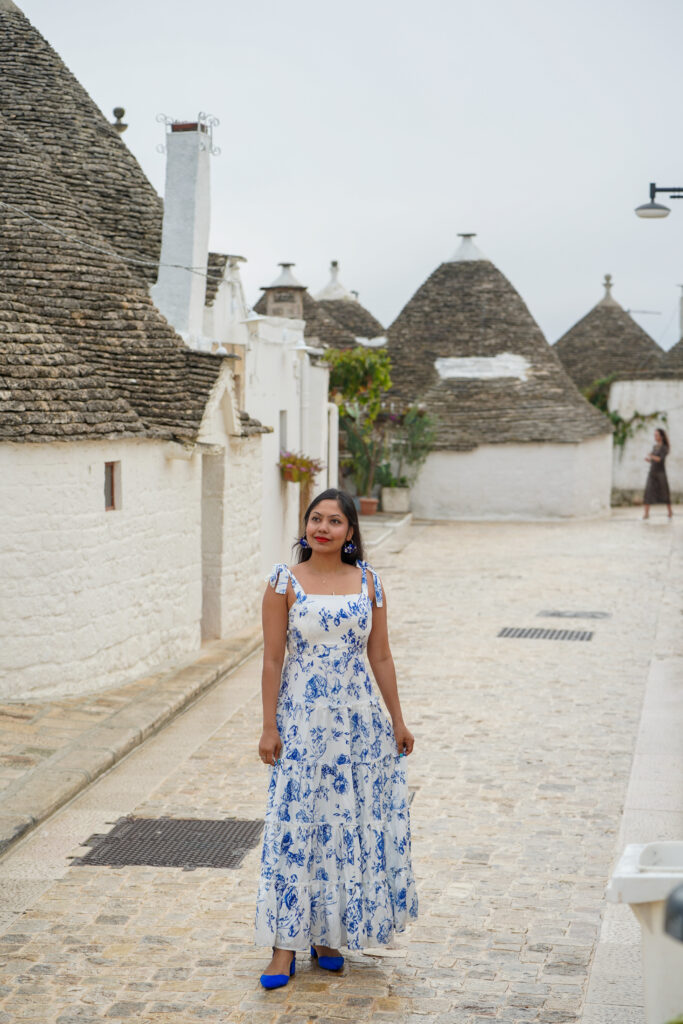
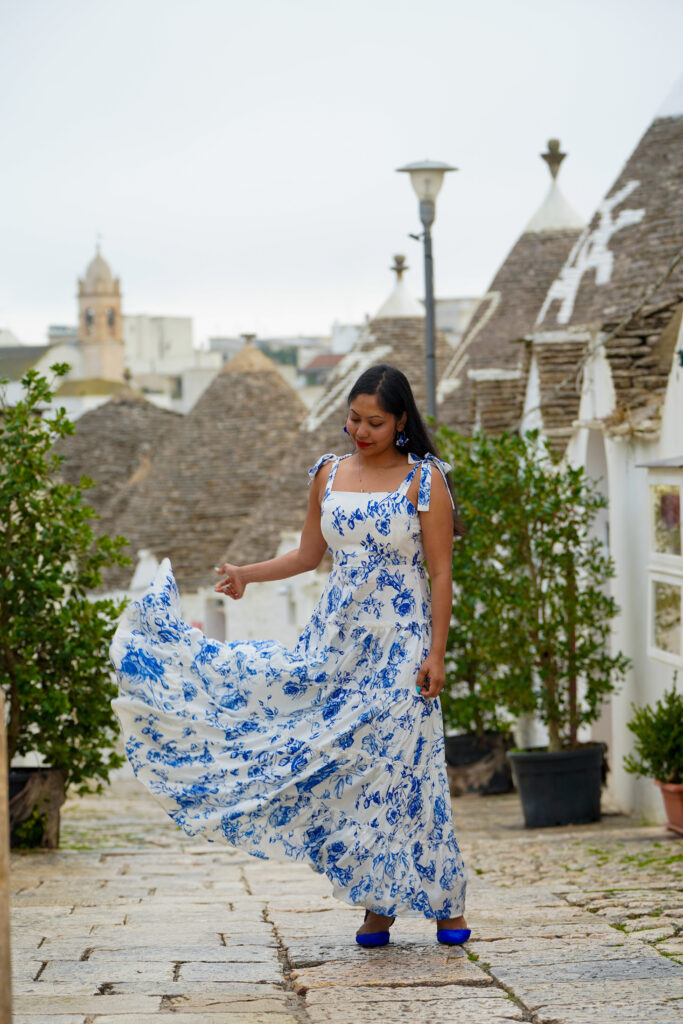
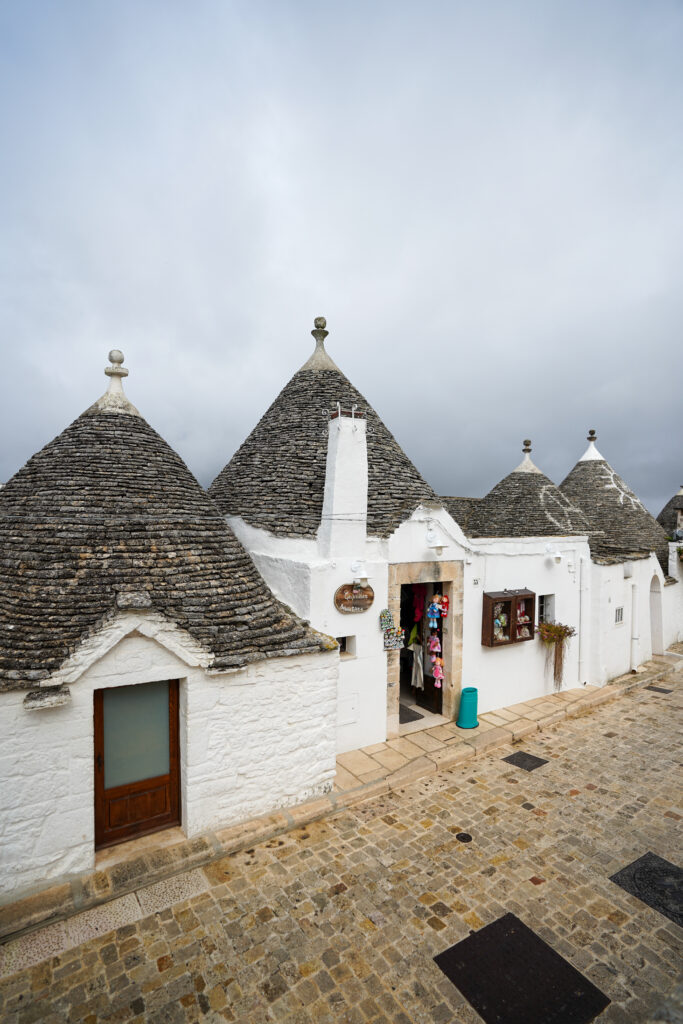

Alberobello, Italy
Practical Tips for Alberobello
Go Early: The difference between 7am and 10am is significant. Arrive at your accommodation the evening before so you can catch sunrise exploration.
Wear Good Shoes: The streets are steep and cobblestoned. Comfortable, grippy shoes are essential.
It’s Small: The entire trulli town takes maybe 2-3 hours to walk if you’re moving steadily. Two days is perfect for slow exploration without rushing.
Parking: Park on the outskirts and walk in. The historic center isn’t designed for cars, and parking in the center is complicated and expensive.
Stay Overnight: Day-trippers and tour groups arrive by mid-morning. Staying in a trullo lets you experience the real magic – the quiet hours before tourism takes over.
Rione Aia Piccola is for Wandering: This quieter district is less photographed but more authentic. Spend time here to see Alberobello as it actually is, not as it’s marketed.
The Magic of Alberobello
There’s something about a place that looks exactly like the fairytale version of itself. Alberobello doesn’t disappoint or deceive – it’s genuinely as charming as the photos suggest. But the real magic isn’t in the photos. It’s in waking up at 7am and walking empty streets surrounded by stone cone roofs, in finding a tiny piazza with a single cafe, in turning a corner and discovering a view you weren’t expecting.
It’s a town that rewards early mornings and slow wandering.
Leaving Alberobello: Back to Rome
After two days of early mornings, wandering narrow streets, and sleeping under stone cone roofs, we drove back north toward Rome. Our flight home was departing from Fiumicino, which meant one last night in the capital before heading to the airport.
Planning Your Own Italy Adventure
Italy doesn’t need a perfect itinerary. It needs slow mornings, empty streets at dawn, time to wander without rushing between checkpoints. Whether you’re watching sunrise over rolling Tuscan hills, standing on clifftops in dreamy Positano overlooking the Mediterranean, exploring ancient villages frozen in time on hillsides, or walking through cone-roofed towns that feel like fairytales – the magic isn’t in the destinations. It’s in how you move through them.
Start early. Stay in places that ground you in the actual life of where you are. Take the winding roads. Get lost on purpose. And remember that the best travel moments aren’t the famous spots – they’re the ones you weren’t expecting when you weren’t looking for them.
Italy will still be beautiful when you arrive. The real question is: will you be awake early enough to see it.