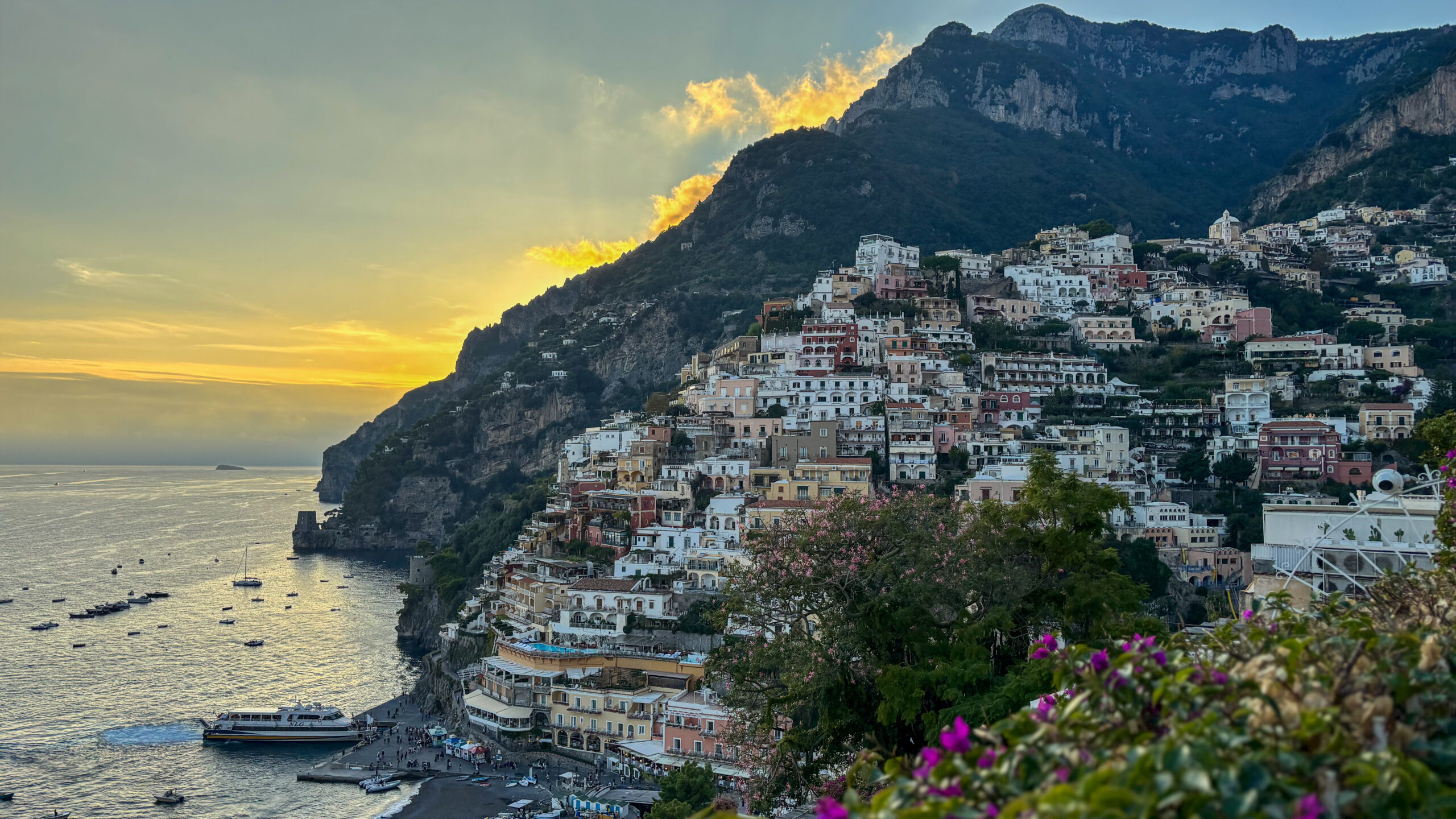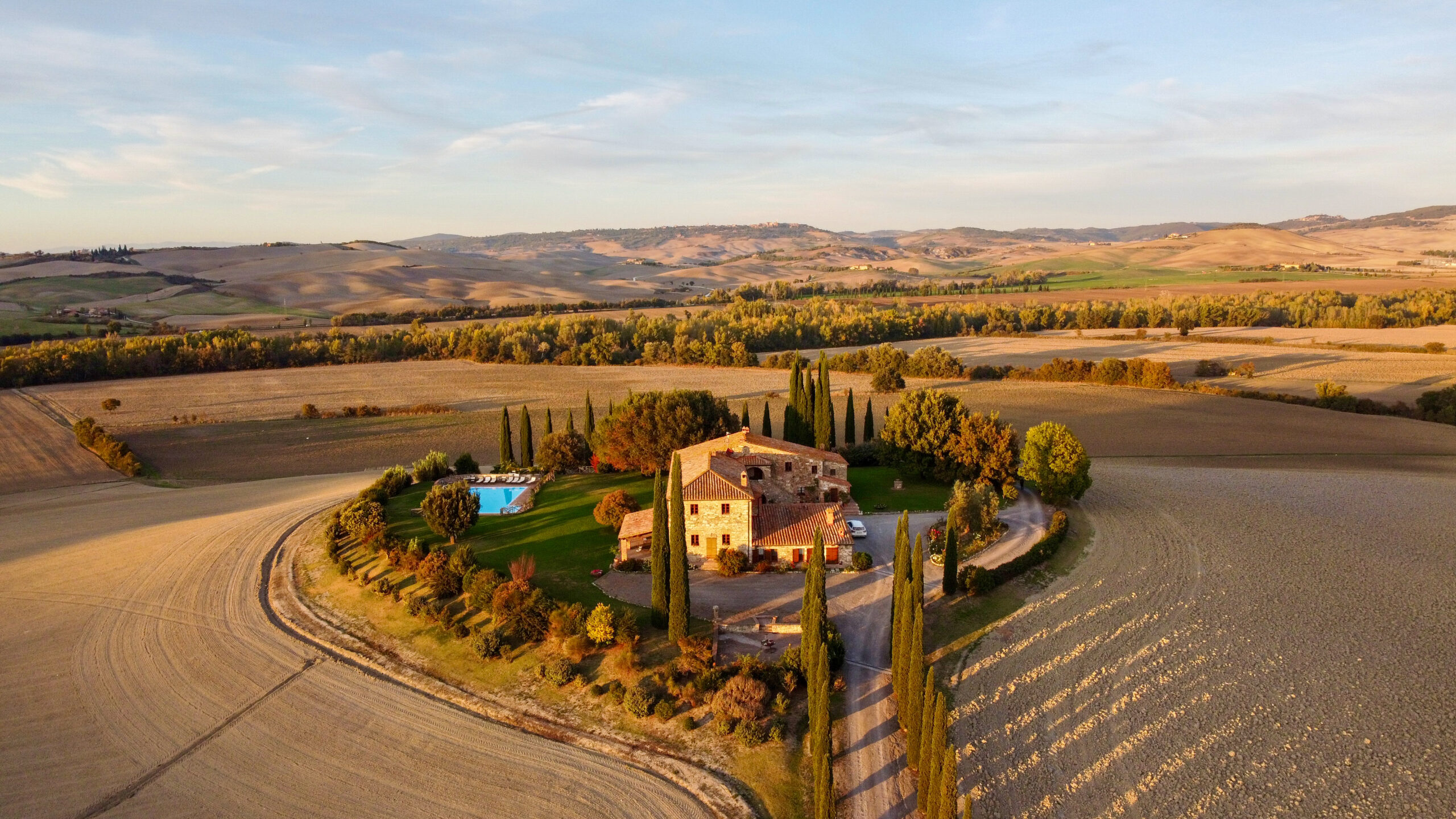
You’ve seen the photos. Rolling hills that look too perfect to be real. Medieval villages perched impossibly on cliff edges. Golden light hitting cypress trees like they’re posing for Instagram. You’ve probably saved these images and thought, “One day, I’ll take a Tuscany road trip.”
The good news? Tuscany really is that beautiful. But to experience more than just the famous viewpoints, you need enough time to slow down and explore.
This 3 day Tuscany road trip itinerary follows the route we personally took through Tuscany, exploring the rolling hills of Val d’Orcia, the landscapes of Crete Senesi, medieval hill towns, and natural hot springs. This guide shares exactly how many days you need in Tuscany, what you can realistically see, and how to make the most of your trip.
Affiliate disclosure: This post contains affiliate links. If you book through one of these links, I may earn a small commission at no additional cost to you.
How Many days do you actually need in tuscany
Minimum: 3 Days
If you want to see the iconic Tuscany – rolling hills, cypress-lined roads, medieval towns, hidden valleys, and actually have time to breathe – you need at least 3 days. Not rushed. Not packed. Just enough time to get a real feel for the region.
3 days lets you:
– Experience at least 4-5 different towns
– Catch sunrise and golden hour (the light is everything)
– Stop at viewpoints without checking your watch
– Sit in a cafe and actually enjoy coffee instead of gulping it
– Feel the rhythm of Tuscany, not just see it
We completed this Tuscany itinerary in 3 days while traveling with our son, and it felt like the perfect balance between exploring and slowing down. We had full days, but we never felt like we were just rushing from one place to another.
If you have 4-5 days? Even better. Add wine tastings, longer hikes, more meals with a view.
Planning a bigger Italy road trip? Tuscany was just one part of our journey through Italy. We combined the rolling hills of Val d’Orcia with the dramatic Amalfi Coast and the fairytale trulli houses of Alberobello in our 8-day Italy road trip itinerary.
Best Time to Visit tuscany
Tuscany is beautiful year-round, but the best time to experience its rolling hills, charming villages, and vineyards is during May – June and September – October. Spring brings fresh greenery and colorful wildflowers, while early autumn offers warm days, golden landscapes, and fewer crowds. July and August can be challenging with intense heat, busy attractions, and higher accommodation prices, so consider visiting outside the peak summer months for a more relaxed Tuscan experience.
Money & Payments
Credit and debit cards are widely accepted across Tuscany, especially at hotels, restaurants, and larger shops. However, it’s always a good idea to carry some cash because small cafés, family-run shops, market stalls, and rural restaurants may still prefer cash payments. ATMs (called Bancomat in Italy) are available in most towns, but smaller villages may have limited options, so withdrawing some euros in advance is a smart idea.
driving Tips
Driving through Tuscany is one of the best ways to experience its hidden villages and breathtaking countryside. Main roads are generally well-maintained, but smaller rural roads can be narrow, winding, and require extra attention – especially when passing through hill towns.
If you’re driving from cities like Rome or Florence, you’ll likely use Italy’s toll highways (Autostrade). Most toll booths accept credit cards, debit cards, and cash. Speed limits are monitored by cameras, and fines can apply even if you are only slightly over the limit.
Gas stations are easier to find in larger towns, while countryside stations may have limited hours, especially on Sundays. It’s best to fill up before heading into more remote areas. Italian drivers can be more confident and quick compared to North American driving styles, so stay calm, drive defensively, and don’t feel pressured to match their pace.
Dining Tips
Meal times in Italy are different from North America. Lunch is usually enjoyed between 12 PM and 2 PM, while dinner often starts later, around 7 PM to 9 PM. Many family-run restaurants close one day a week, often on Mondays or Tuesdays, so check opening hours before visiting.
During the busy summer months, reservations are recommended in popular towns. For an affordable and authentic meal, look for the “menu del giorno” (daily menu), which often offers great value with local dishes.
IMPORTANT: understand ZTL Zones before you drive
What Is A ZTL Zone?
ZTL stands for “Zona a Traffico Limitato” (Limited Traffic Zone). It’s an Italian traffic restriction system that exists in many historic towns.
Here’s what it means: Only authorized vehicles (residents, deliveries, taxis, buses) can enter these zones. If you drive into a ZTL zone without permission, your license plate is automatically photographed by cameras, and you’ll receive a fine in the mail weeks or months later.
The Fine: Usually €80-150 per violation. Yes, they will find you even if you’re a tourist. Yes, the rental car company will track you down and charge your credit card.
Why Do ZTL Zones Exist?
Tuscany’s medieval towns were built hundreds of years ago when people didn’t have cars. Streets are narrow. Parking is nonexistent. Too many cars damage historic architecture. ZTL zones protect these towns from traffic chaos while preserving their character. It makes sense. It’s also frustrating if you accidentally drive into one.
How To Avoid ZTL Zones
1. When you rent your car, ASK the rental company about ZTL zones in your specific destinations. Tell them your itinerary.
2. Watch for signs at town entrances. If you see a white box with red border and a car with an X through it – STOP. That’s a ZTL warning.
3. Use common sense: If streets are too narrow for two cars to pass, assume there’s a ZTL. Park outside and walk in.
4. Ask your hotel/accommodation. When you arrive anywhere, ask staff: “Is there a ZTL zone in this town center? Where should I park?”
5. The simple rule: Park outside every medieval town and walk in. Yes, it’s a short walk. It’s also safer and you’ll see more.
What If You Accidentally Enter A ZTL?
If you drove into a ZTL without knowing, don’t panic. You’re photographed, but you can still leave. Exit the zone, park outside, and accept that you’ll likely get a fine. It’s frustrating, but it’s not a catastrophe. Many travelers accidentally get one ZTL fine. The rental company will contact you weeks later, and you’ll pay it.
Getting to tuscany from rome (with or without a car)
THE BEST OPTION: Rent A Car
Here’s my honest opinion: Tuscany without a car is possible, but it’s not the same experience. The whole magic of Tuscany is freedom – stopping at random viewpoints, taking scenic detours, discovering tiny villages that aren’t on the main route.
When we landed in Rome, we picked up our rental car at Fiumicino Airport and headed straight north to Tuscany. No spending time in Rome. No public transport logistics. Just freedom.
Why Renting A Car Is Worth It:
– You can stop at tiny viewpoints along the way
– You can take detours that aren’t on the main route
– You can visit villages that buses don’t reach
– You can leave when you want, not when the bus schedule says
– With a baby/kids, it’s infinitely easier than public transport
Tip: Book your rental car in advance, especially if you are visiting during summer or peak seasons. Airport rentals can become more expensive closer to your travel dates. Book your rental car here.
How to Get From Rome to Tuscany Without a Car
If you’re planning to explore Tuscany but don’t want to drive from Rome, you still have a couple of good options. Public transportation can get you to the region, although reaching the smaller countryside villages will take a bit more planning.
Option 1: Travel by Train, Then Continue by Bus
One of the easiest ways to reach southern Tuscany is by train before switching to regional buses.
Common routes include:
- Rome → Siena (usually with one train connection), taking approximately 3–4 hours.
- Rome → Chiusi–Chianciano Terme, which takes about 1 hour 40 minutes to 2 hours, followed by a local bus into Val d’Orcia.
Expect to pay roughly €20–€60 or more, depending on the type of train you choose and how far in advance you book your tickets.
From Siena or Chiusi, regional buses connect to several of Val d’Orcia’s best-known towns, including:
- Pienza
- Montepulciano
- Montalcino
- San Quirico d’Orcia
Keep in mind that bus schedules are less frequent than train services, particularly during weekends, public holidays, and the quieter travel seasons. Checking the timetable before your trip is highly recommended.
Why choose this option?
- Budget-friendly compared with renting a car or booking private transfers.
- A good choice if you plan to stay in one town and explore at a slower pace.
- Ideal for travelers who prefer not to drive in Italy.
Things to consider
- Some villages have only a handful of buses each day.
- Reaching scenic viewpoints, wineries, and countryside photo spots can be difficult without your own vehicle.
- Longer waiting times between connections may reduce the amount of sightseeing you can fit into a day.
Option 2: Take the Train to Florence, Then Rent a Car
If you’d rather avoid driving through Rome’s busy streets but still want the freedom of a road trip, this is one of the most practical options.
Start by taking a high-speed train from Rome Termini to Florence Santa Maria Novella. The journey usually takes around 1 hour 30 minutes to 1 hour 45 minutes, with tickets commonly starting around €20when booked in advance and increasing closer to the travel date.
Once you arrive in Florence, pick up your rental car and begin your drive through the Tuscan countryside. Having a car makes it much easier to explore places such as:
- Chianti
- San Gimignano
- Val d’Orcia
- Montepulciano
- Pienza
- Saturnia Hot Springs
Book your rental car here in Florenece.
Why choose this option?
- Skip the stress of driving out of Rome.
- Enjoy the flexibility to stop at scenic viewpoints whenever you like.
- Easily visit vineyards, hilltop villages, and hidden countryside roads that are difficult to reach by public transport.
- Perfect for following a road trip itinerary at your own pace.
Good to know
Florence’s historic centre is covered by ZTL (Limited Traffic Zone) restrictions. If you’re renting a car, avoid driving into these restricted areas unless your accommodation has arranged access. Many visitors collect their rental car near Santa Maria Novella station or from offices located outside the ZTL before heading into the countryside.
My Recommendation
If your goal is to experience Tuscany’s rolling hills, quiet country roads, vineyards, and famous viewpoints, renting a car is by far the easiest and most rewarding option. Public transportation works well for visiting the larger towns, but many of Tuscany’s most memorable landscapes and hidden gems simply aren’t accessible by train or bus.
Option 3: Organized Tour From Rome/Florence
If you prefer not to drive in Italy, an organized Tuscany day tour is the easiest way to experience the region from Florence or Rome.
Personally, I believe renting a car gives you the ultimate Tuscany experience — the freedom to stop at hidden viewpoints, take scenic detours and explore small villages at your own pace. However, I completely understand that driving in a foreign country is not for everyone.
After researching the best options, these are the tours I would consider if I did not have access to a car.
1. Tuscany Highlights Tour: Pisa, San Gimignano, Chianti & Siena (From Florence)
Best for: First-time visitors who want to see Tuscany’s most famous highlights in one day.
This is one of the most popular Tuscany day tours, covering some of the region’s most iconic destinations:
- Pisa and the famous Leaning Tower
- Medieval San Gimignano
- Siena’s historic centre
- The Chianti countryside
More than 8,000 travelers have booked this experience, and it has received strong reviews with a 4.4/5 rating.
Why I like this tour:
– Covers several bucket-list Tuscany locations in one day
– No need to worry about driving, parking or ZTL zones
– Great option if Florence is your base
Book the Tuscany Highlights Pisa, San Gimignano, Chianti & Siena Day Tour here
2. Val d’Orcia Scenic Tour With Wine Tastings (From Florence)
Best for: If you want to experience the Tuscany’s countryside experience.
If your dream Tuscany includes rolling hills, vineyards, charming villages and famous wine regions, this is the type of tour I would choose.
The tour includes:
- Scenic drives through the Val d’Orcia countryside
- Montalcino and Montepulciano
- Wine tasting experiences
- Pienza, with beautiful views over the Orcia Valley and local cheese tasting
More than 1,000 travelers have booked this experience, and it has received a 4.3/5 rating.
Why I like this tour:
– Focuses on the Tuscany landscapes many travelers dream about
– Includes famous wine towns
– Less rushed than trying to cover every major highlight
Things to know:
– Long day from Florence
– Not ideal if you want to visit Pisa as well
Book the Val d’Orcia Scenic Tour with Wine Tastings here
3. Florence and Pisa Day Tour From Rome
Best for: If you are staying in Rome who only have one day available.
If Tuscany is not part of your main itinerary but you still want to see Florence and Pisa, this is a convenient option.
More than 2,000 travelers have booked this tour, and it has a 4.4/5 rating.
Why it works:
– Convenient if Rome is your base
– No need to arrange trains between cities
– Good introduction to Florence and Pisa
Things to know:
– Extremely long day
– Limited time in Florence
– You miss the slower countryside experience that makes Tuscany special
Book the Florence and Pisa Day Tour from Rome here
Before you leave anywhere: Get An e-Sim
The single best travel hack for exploring Tuscany: get an eSIM before you land.
We activated an Airalo Italy eSIM the moment we landed in Rome, and it changed everything. Instead of hunting for wifi at cafes or being lost without GPS, we had reliable data from the second we started driving. Get Your eSIM Here.
Setup is literally: download the app, buy the plan, scan the QR code. You have data before you leave the airport.
DAY 1: Rome To Val d’Orcia – Rolling hills & Dreamiest views
MORNING: Rome Fiumicino Airport → Val d’Orcia
Distance: Approximately 220 km
Driving Time: 2.5 – 3 hours
Road Conditions: Easy highways, then scenic country roads
Here’s what happened the day we arrived: we picked up our rental car at Rome Fiumicino Airport and didn’t stop for anything. Since we had limited time and wanted to experience the countryside, we chose to start our Tuscany adventure immediately after landing.
The drive itself is beautiful. You start on busy highways around Rome, and gradually – like a scene slowly coming into focus – the landscape transforms. Highways give way to winding country roads. City chaos becomes countryside quiet. Vineyards appear. Olive groves dot the hillsides. And then, suddenly, you’re driving through the Tuscany of postcards.
Every kilometer feels like you’re getting closer to somewhere that looks too beautiful to be real.
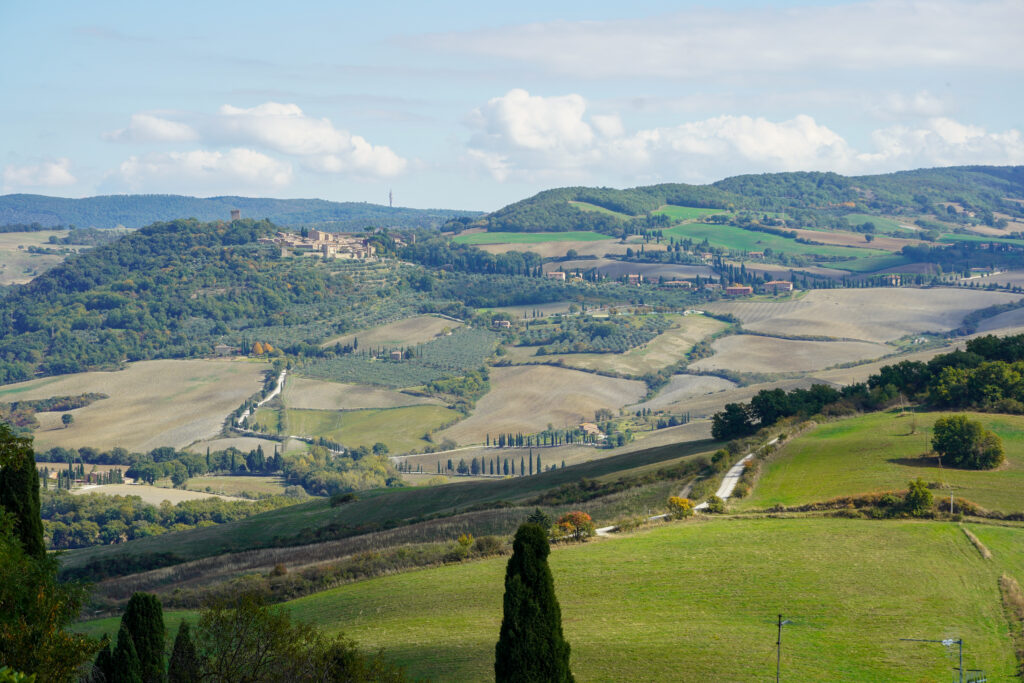
Tuscany’s Most Beautiful Countryside View
Afternoon: Arrive At Your Accommodation & Settle In
Where We Stayed: Casanova Panoramic Rooms & Suites.
We splurged on one of their panoramic rooms with a private balcony, and it was worth every euro. The moment we stepped onto that balcony, everything stopped.
Endless rolling hills. Cypress trees. Golden fields. The late afternoon sun painting everything in warm shades of honey and amber. It looked exactly like Tuscany looks in magazines – except somehow even more beautiful in person. As we sat there overlooking Val d’Orcia, it finally hit us: we were actually here.
Instead of rushing off to explore, we did something we never do: we just sat. Relaxed. Watched the light change across the hills. We had nowhere to be and nowhere we needed to go.
Dinner At The Hotel Restaurant
As evening approached, we headed to La del Barbarossa, the hotel’s restaurant, for our first real Tuscan meal. Traditional dishes. Regional wines. Panoramic views stretching across the valley. Every bite felt fresh, authentic, and wonderfully uncomplicated – the kind of food that reminds you why people travel to Italy just to eat.
Evening: Golden Hour & Sunset
We left the balcony doors open and watched the sun slowly disappear behind the hills. The countryside grew quiet. The stars appeared. And for the first time in months, there was nowhere else we needed to be.
Travel Tip: If your budget allows, book a panoramic room with a balcony. Waking up to uninterrupted views of Val d’Orcia is one of those experiences that changes how you see travel. We still talk about that view.
DAY 2: The quiet side of tuscany – clay hills, medieval towns & golden hour magic
This day was our favorite. It felt like we’d discovered Tuscany that tourists don’t usually see.
Morning: Crete Senesi – The Moonscape
What Is It: Crete Senesi is a landscape region (not a single town) spread across clay hills between Siena and Asciano. Most of the dramatic formations you see in travel photos are on private farmland, which is why you can’t always get close. But the views from the roads are absolutely worth it.
How To Visit:
– Drive the provincial roads (SP438 toward Asciano or the roads around Buonconvento)
– Stop at roadside pull-offs when you spot stunning views
– Turn on your hazard lights if you’re stopping along curves (these roads wind constantly)
– Some viewpoints have small parking areas; most are just informal pull-offs
The Best Photo Spot:
There’s an iconic cypress-lined road leading to Podere Baccoleno (just south of Asciano) that looks straight out of a fairy tale. It’s private property and gated, so you can’t drive it. But here’s the workaround: park at the nearby crossroad (space for 3-4 cars) and photograph from there. The shot is still absolutely stunning.
Pro Tip: Visit during golden hour (late afternoon/early evening). The light transforms everything.
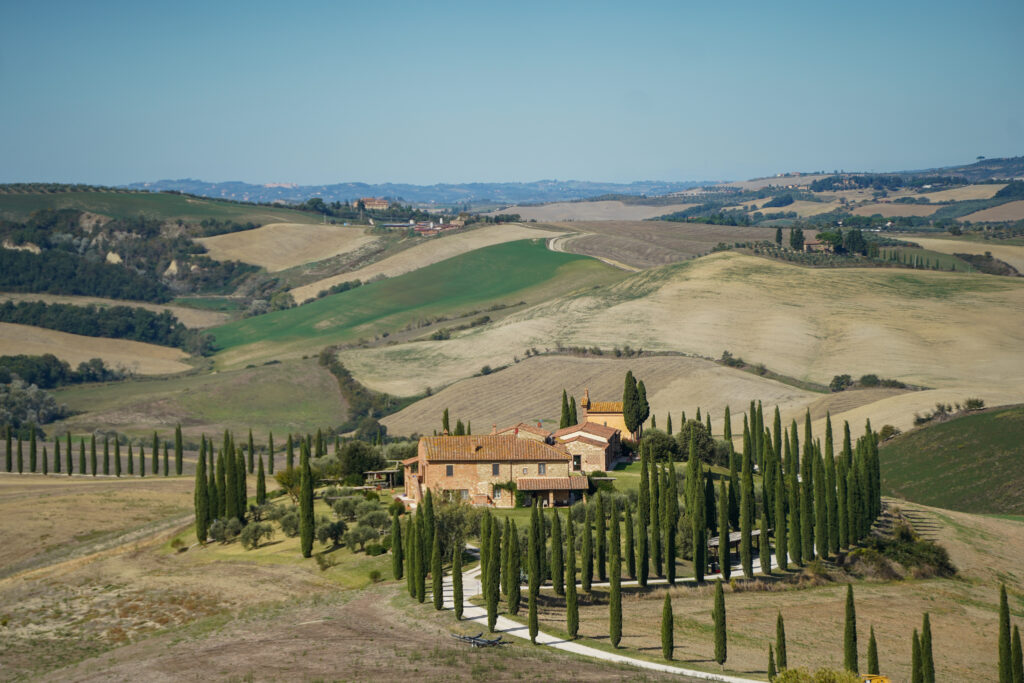
Rolling hills and cypress trees in Crete Senesi and Val d’Orcia, Tuscany Italy
Late Morning: Asciano
After viewing Crete Senesi, we headed to Asciano, a tiny medieval town sitting at the edge of this surreal landscape. We parked at the town’s edge and just walked.
ZTL Status: ZTL Restrictions Apply
Parking: The best option is to park outside the historic centre and explore Asciano on foot. The old town’s medieval streets are narrow and were not designed for modern vehicles. Even where access is allowed, driving through the historic area can be challenging, so parking nearby and walking is the easiest and most enjoyable way to experience the town.
Unlike the busier Tuscan towns, Asciano felt genuinely lived-in. Narrow, winding streets. Medieval architecture that hasn’t been polished for tourists. No tour groups. No massive crowds. Just you, stone buildings, and that Tuscan light hitting everything just right.
What Makes Asciano Special:
It feels untouched. The medieval passages are tight and narrow. You get a real sense of stepping back in time without feeling like you’re walking through a theme park.
Things To Do:
– Wander the narrow streets without a plan (seriously, this is the best thing to do)
– Find a small cafe tucked into an alley and sit with coffee watching the light change
– Visit the Abbey of Monte Oliveto Maggiore nearby (a stunning monastic complex hidden in the woods)
– If you visit in September, there’s the “Palio dei Ciuchi” – a unique local event where districts race each other on donkeys instead of horses.
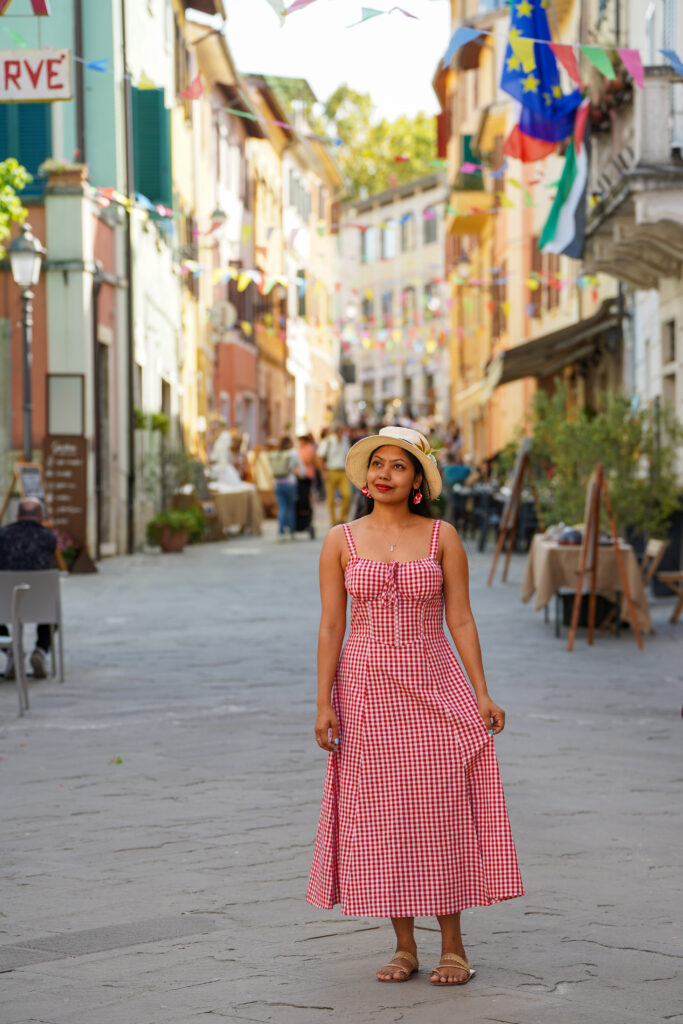
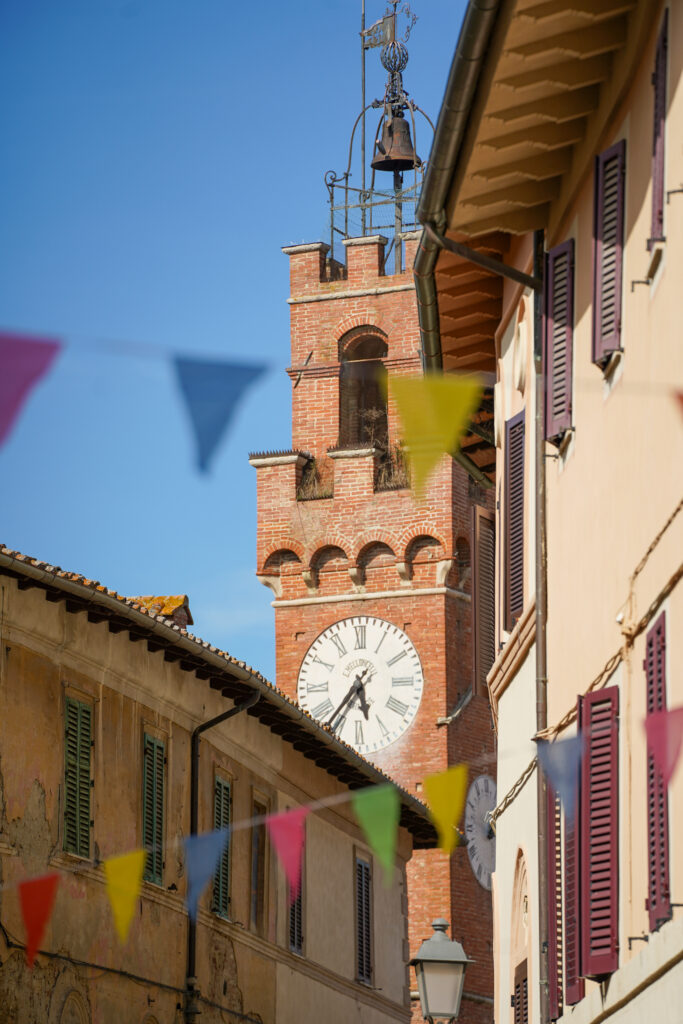
Asciano, Tuscany
Midday: Monteriggioni – The Medieval Crown
Drive Time From Asciano: About 30 minutes
Monteriggioni appears on the horizon like a stone crown resting on a hill. It’s small but perfectly preserved. Medieval walls. Fourteen watchtowers. Historic center. It’s exactly what you imagine a Tuscan medieval town to be.
ZTL Status: ZTL Restrictions Apply
Parking: Parking is available outside the medieval walls at the designated parking areas near the entrance to Monteriggioni. From there, it is only a short walk to the castle gates and historic centre. Parking is usually paid (around €2–3 per hour or a daily rate may be available, depending on the season). During the busy summer months, arrive earlier in the day because spaces can fill up quickly.
What To Do:
– Walk the narrow streets through the historic center
– Explore the central piazza
– Climb up to the walls for views over the countryside
– Have lunch inside the medieval center
Where To Eat:
Ristorante Le Torri is right on the main piazza. Classic Tuscan dishes – wild boar pappardelle, Florentine steak, ribollita soup. The setting in the medieval square makes it feel special.
If You Have A Drone:
This is one of the most rewarding aerial locations in Tuscany. From above, the circular medieval walls with 14 towers sitting atop a hill look like something straight out of a fantasy movie. The symmetry, the walls, the way it sits on that hill – it’s drone photography gold.
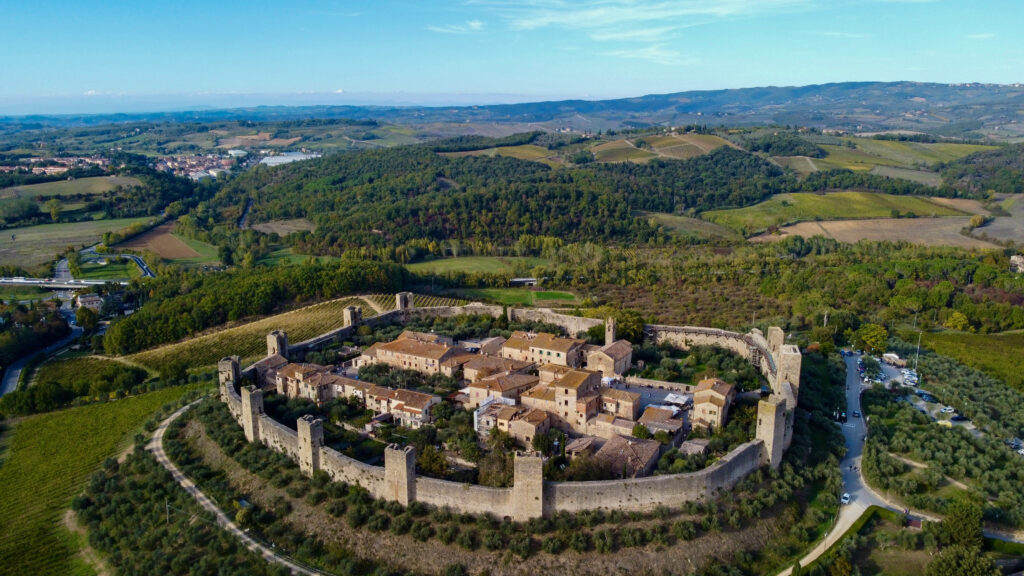
Monteriggioni, Tuscany
Evening: Podere Poggio – The Golden Hour Finale
Drive Time From Monteriggioni: About 45 minutes south
Go in the evening. Seriously, don’t show up mid-day.
Parking: This is a private property on the countryside. There is no official visitor parking area, so if you stop for photos, pull over safely and be respectful of the property.
Podere Poggio is a stone farmhouse with a pool, surrounded by Tuscan countryside. On its own, it’s nice. But when that golden light hits in late afternoon? It becomes something else.
Our Experience- The soft golden light fell across the house and pool, and the entire scene looked almost unreal – like someone had carefully edited every detail. The cypress trees stood perfectly against the glowing sky, while the stone walls turned a warm honey color as the sun slowly disappeared.
The fading light brought out every curve and texture of the clay hills, creating dramatic shadows across the landscape. This is the moment Tuscany photographers dream about. This is what we came to Tuscany for.
We ended our Day 2 here, sitting at the property watching the light change across the valley, and it was magical. By the time we left, the sun had set and the countryside was bathed in that blue-hour light that photographers dream about.
Practical Note: Podere Poggio is a private property, but it’s a well-known photo spot. You can stop to take photos from the roadside, but be respectful of the owners.
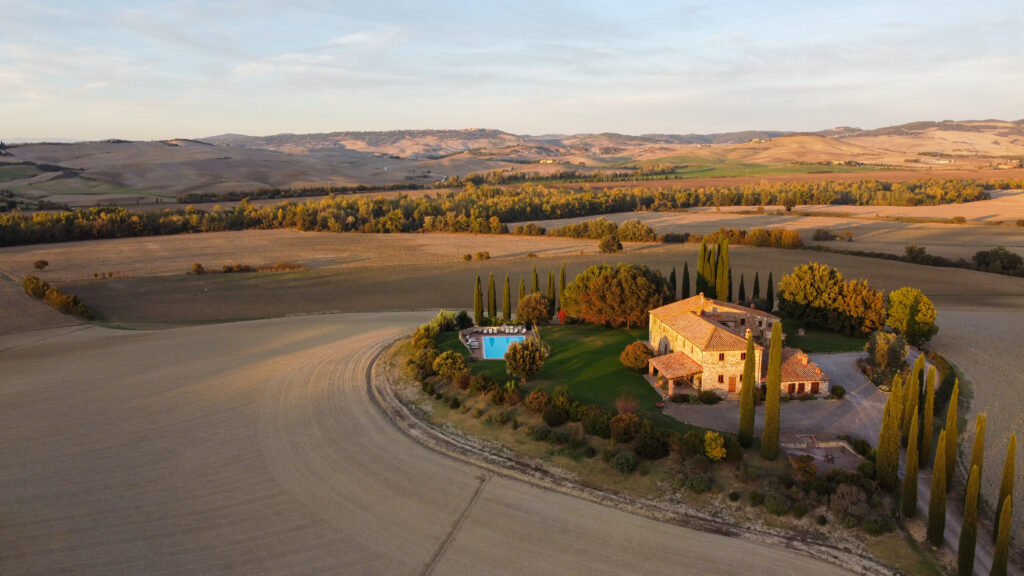
Podere Poggio glowing at golden hour, surrounded by the rolling hills
DAY 3: Cypress ring, Perfect Towns & Hot Spring
Morning: The Cypress Tree Ring – Val d’Orcia’s Most Distinctive Photo Stop
Tucked among the rolling hills of Val d’Orcia, the Cypress Tree Ring is one of Tuscany’s most recognizable photography locations. A perfectly spaced circle of cypress trees surrounds a quiet grassy clearing, creating a striking geometric pattern against the surrounding countryside.
Location: Val d’Orcia, a short drive from Pienza and San Quirico d’Orcia.
From the parking area, a brief walk along a farm track leads to the viewpoint. At ground level, the grove feels surprisingly peaceful and secluded, but its full beauty becomes apparent from above.
We visited in October, when the surrounding fields had turned a rich golden color. The contrast between the dark green cypress trees and the warm autumn landscape made this one of the most memorable scenes of our Tuscany trip.
If you have a drone, this is one of the rare locations where the aerial view completely transforms the experience. From above, the circular arrangement of the trees stands out dramatically against the patchwork of Val d’Orcia’s fields and hills.
If you don’t have a drone, the stop is still well worth the short walk. The ring of trees naturally frames the clearing, making it an excellent spot for wide landscape shots and portraits.
Photography tip: Visit at sunrise or during the last hour before sunset for the softest light, longer shadows, and fewer visitors.
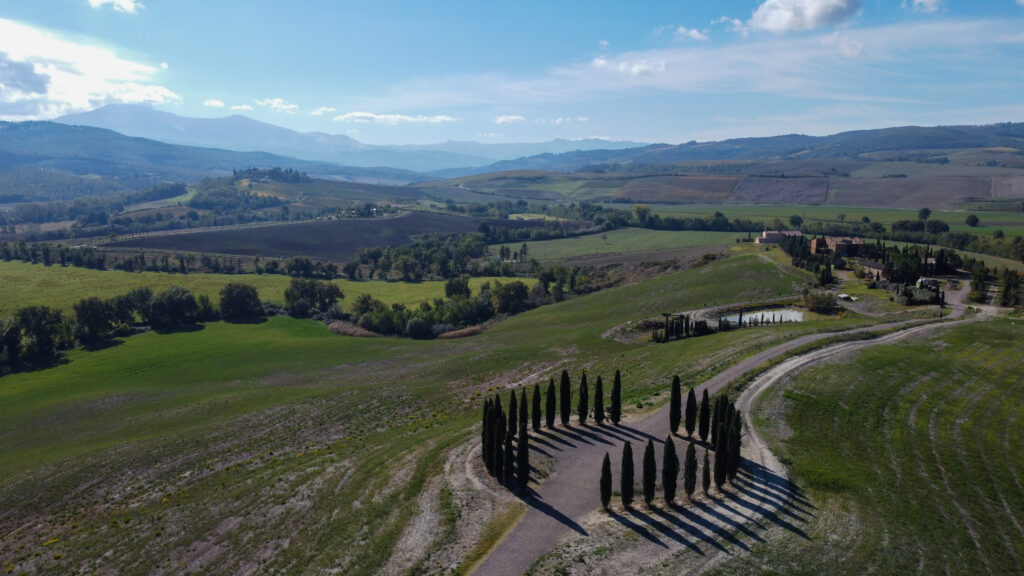
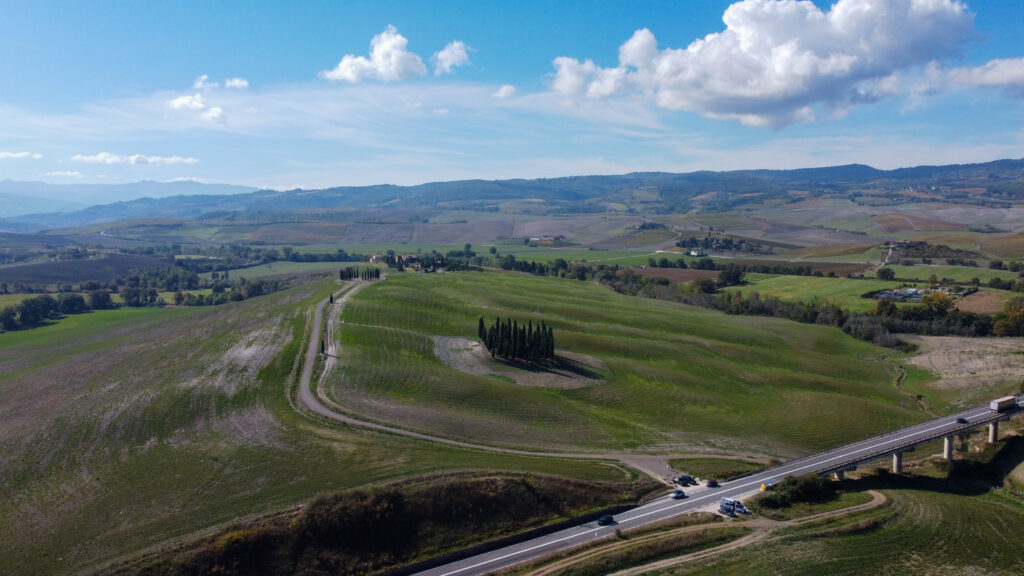
Cypress Tree Ring
Pienza – The Town Designed As Art
Drive Time: From Cypress Tree Ring to Pienza is approximately 10–15 minutes by car.
Pienza has a ZTL (Zona a Traffico Limitato) in its historic center.
Here’s what you should know:
- You can drive to Pienza, but don’t drive into the old town unless you have authorization (such as certain hotel arrangements).
- Park outside the ZTL in one of the public parking lots and walk into the historic center. The walk is usually only a few minutes.
The most commonly used parking areas are:
- Parcheggio P1
- Parcheggio P2
- Parcheggio P3
These lots are convenient and within easy walking distance of the town center.
We hit Pienza in the morning, and here’s something that surprised us: it’s actually easy to navigate. Most Tuscan hill towns have you climbing steep streets and stairs constantly. Pienza is different. Mostly level. Smooth walkways. Gentle slopes.
Why? Back in the 1400s, Pope Pius II, who was born here, transformed Pienza into what he envisioned as the Renaissance “ideal city.” Symmetrical buildings. Central square. Everything proportioned intentionally. Walking through it, you can see what he was going for – it all lines up in this very deliberate, harmonious way.
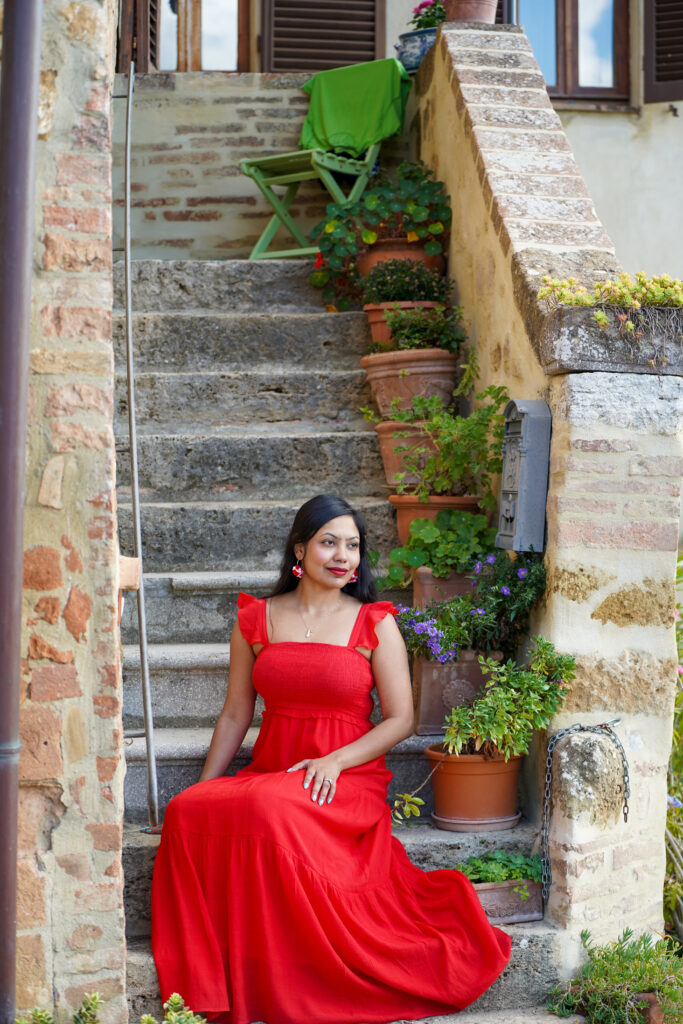
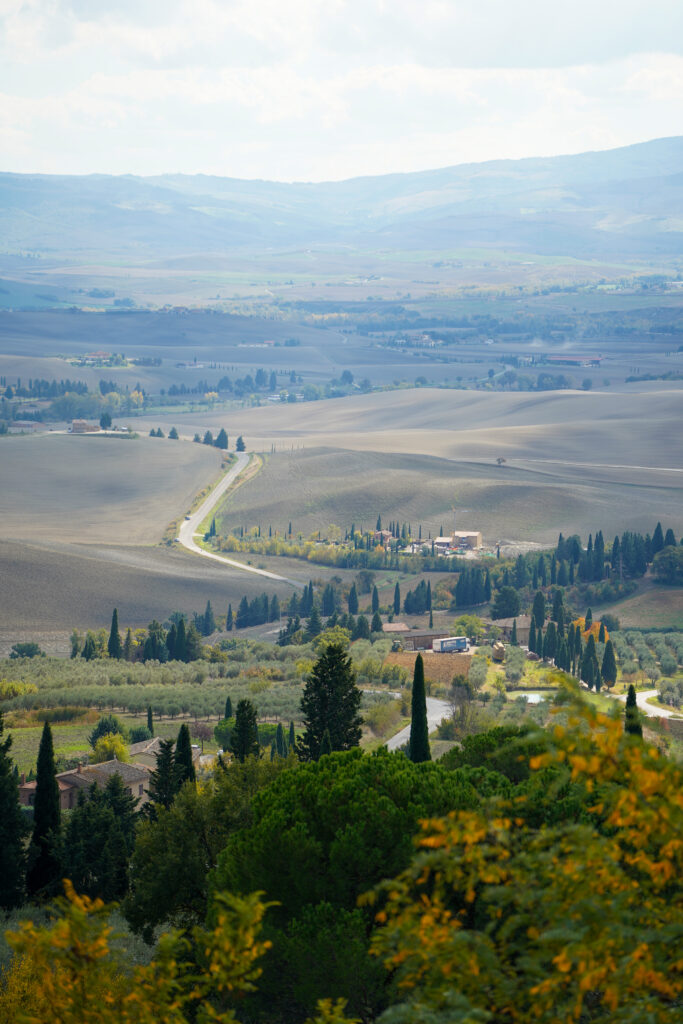
Pienza, Tuscany
What To Do:
– Walk to the edge of town where the walls overlook Val d’Orcia
– The valley spreads out below – rolling hills, cypress trees, that classic Tuscan view
– Grab pecorino cheese (the town is famous for it) from any shop and find a bench along the walls
– Enjoy one of the best views in Tuscany while eating the local specialty
Travel Tip: If your budget allows, spend the night in Pienza instead of hurrying through. The town is stunning at sunset, and even better at sunrise when it’s quiet.
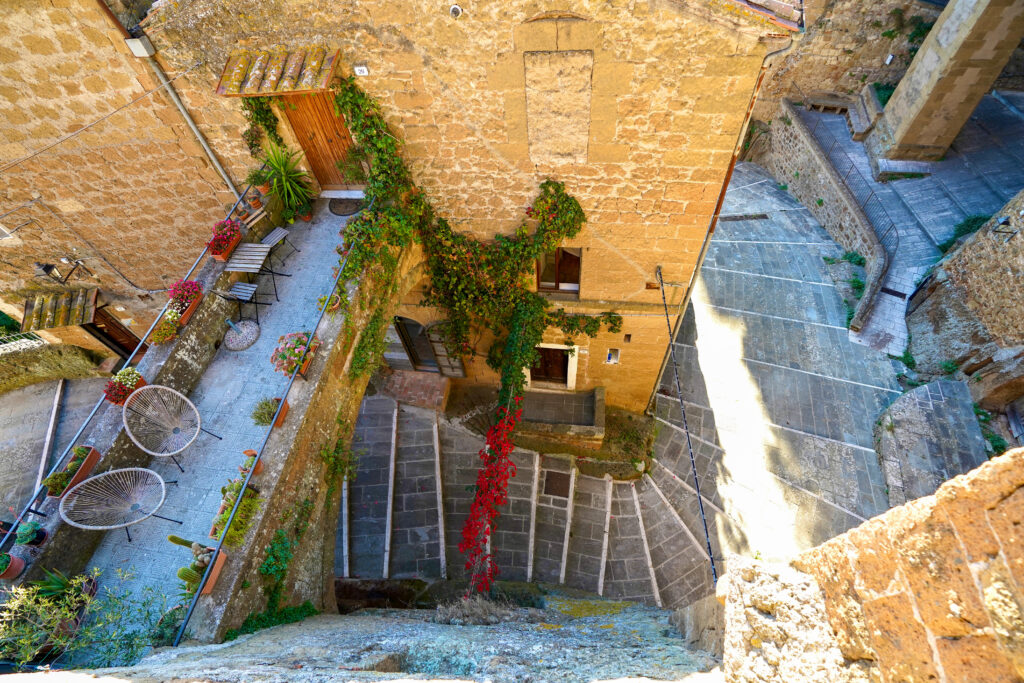
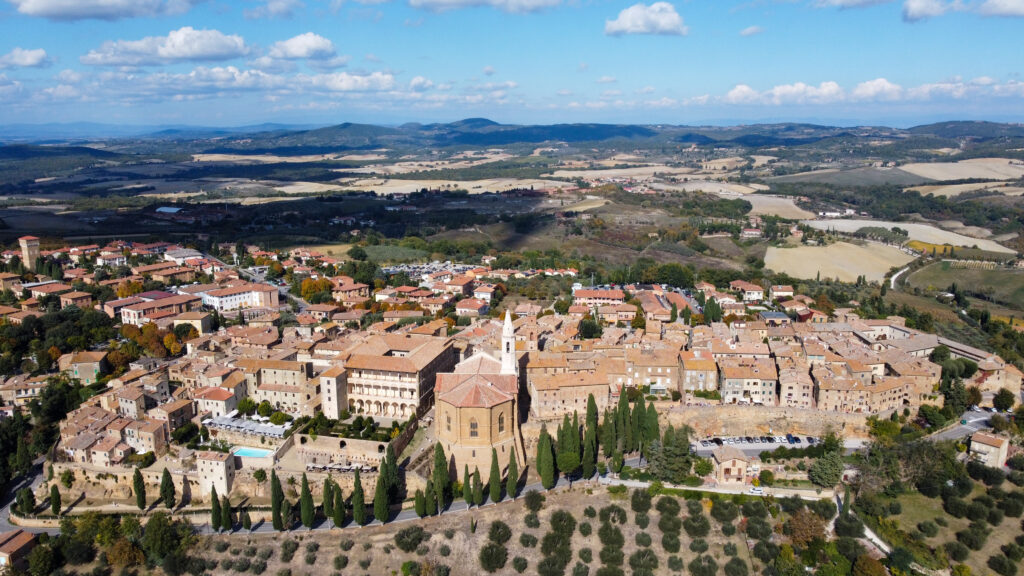
Pienza from above, where centuries of history meet the rolling hills of the UNESCO-listed Val d’Orcia
Pitigliano – Tuscany’s “Little Jerusalem” Carved into Stone
Drive Time from Pienza: About 1 hour 15 minutes
The drive south takes you through rolling Tuscan countryside before Pitigliano suddenly comes into view.
The entire medieval village sits atop a cliff of golden volcanic tuff, with houses that seem to grow directly out of the rock face. Buildings and stone plateau merge so completely that it’s hard to tell where nature ends and architecture begins. When the evening sun hits, everything glows warm amber.
Why visit Pitigliano?
Known as “Little Jerusalem,” Pitigliano became a refuge for Jewish families centuries ago, and their history is still an important part of the town today. As you wander through the Jewish Quarter, you’ll find a beautifully preserved synagogue, ritual baths, ancient wine cellars, and a traditional bakery, all carved into the soft volcanic rock.
While you’re here, don’t miss:
- The impressive Medici Aqueduct, one of the town’s most recognizable landmarks.
- The Vie Cave, fascinating Etruscan roads carved deep into the rock.
- The charming medieval streets lined with cafés, local shops, and hidden corners.
- Before walking into town, stop at the viewpoint near the parking area. It’s the perfect place to take in the breathtaking panoramic view of Pitigliano, where you can see the entire town rising from the volcanic cliff. It’s easily one of the most spectacular views in Tuscany.
Parking
The historic center is a ZTL (Limited Traffic Zone), so you can’t drive into the old town unless you have authorization. Instead, park in one of the public parking areas outside the historic center and enjoy the short walk into town.
Our Experience
We arrived in the late afternoon, and the warm sunlight made the tuff stone glow in beautiful shades of gold. Walking through Pitigliano felt like discovering one of Tuscany’s hidden gems, where every street seemed to tell a different story.
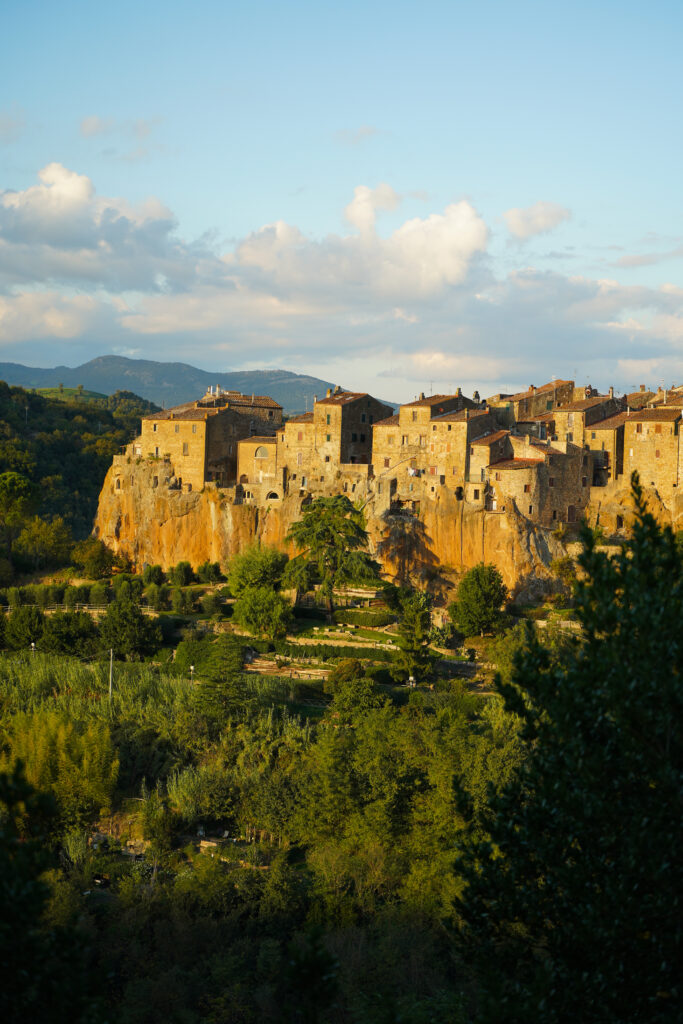
Pitigliano, Tuscany’s spectacular cliffside town, rising dramatically from volcanic tuff rock
EVENING: Saturnia Hot Springs – Nature’s Free Spa
Drive Time from Pitigliano: About 30 minutes
After a day of exploring medieval towns, we made our way to Saturnia Hot Springs – one of the most unique (and completely free) experiences in Tuscany.
Thermal water flows from underground at a constant 37.5°C (99.5°F), cascading over natural limestone terraces into beautiful turquoise pools. The best part? It’s completely free. No entrance fee, no tickets – just arrive, find a spot, and enjoy.
What You Need to Know
Cost: Free to enter. Parking nearby costs a few euros.
Best Time to Visit: Early morning or late afternoon. Midday gets very busy, while sunrise and sunset offer a much more peaceful experience.
What to Bring:
- Swimsuit
- Water shoes (the rocks can be slippery)
- Towel
Good to Know: Remove any jewelry before getting in. The sulfur-rich water can tarnish certain metals.
Don’t Miss the Viewpoint
Before heading down to the hot springs, stop at the unmarked viewpoint overlooking the entire cascade. From above, you can see the steaming turquoise pools winding through the countryside – it’s one of the most breathtaking views in Tuscany.
We visited in the evening, just as everything turned golden. Seeing these natural hot springs in the middle of nowhere felt almost surreal. It was one of those places that makes you stop and think, “I can’t believe somewhere this beautiful actually exists.” It honestly felt like a dream.
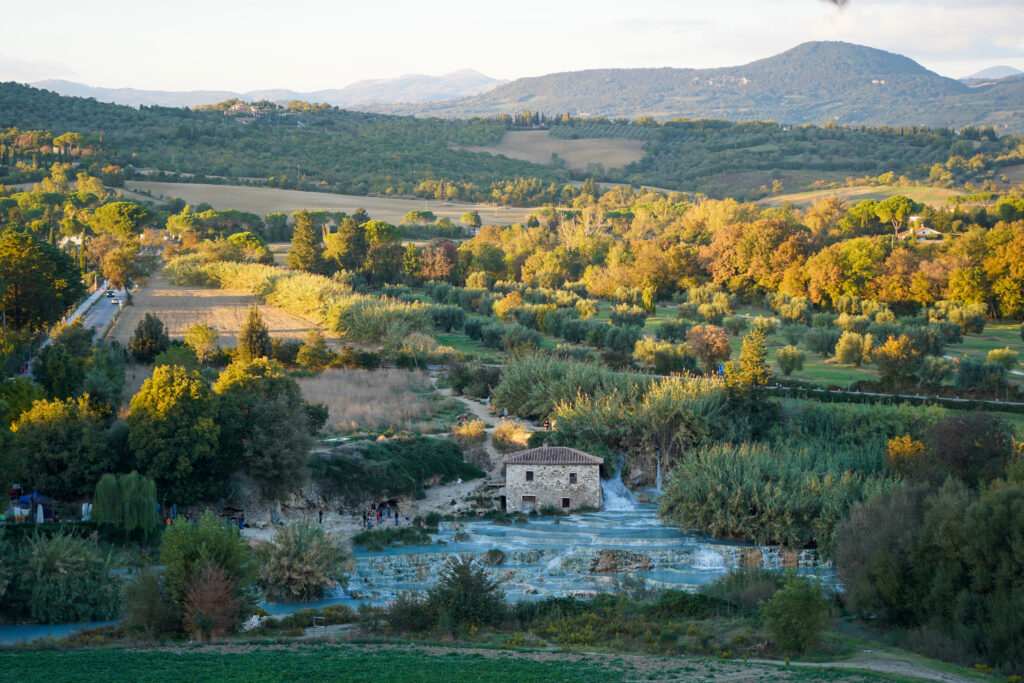
Saturnia Hot Springs
Best Photo Spots in Tuscany
Tuscany is a dream destination for photographers. From endless rolling hills to medieval villages and iconic cypress-lined roads, the scenery feels like a painting at every turn.
During our Tuscany road trip, these were the photo spots that stood out the most.
1. Cypress Tree Ring – One of Tuscany’s Most Unique Photo Spots
Hidden among the rolling hills of Val d’Orcia, the Cypress Tree Ring is one of Tuscany’s most recognizable photography locations. A circle of perfectly spaced cypress trees surrounds a quiet clearing, creating a striking pattern that’s especially beautiful from above.
While it’s impressive from the ground, the real magic comes from a drone, where you can fully appreciate its unique shape against the surrounding countryside.
Photography Tip: Visit during sunrise or late afternoon when the long shadows cast by the cypress trees add depth and drama to your photos.
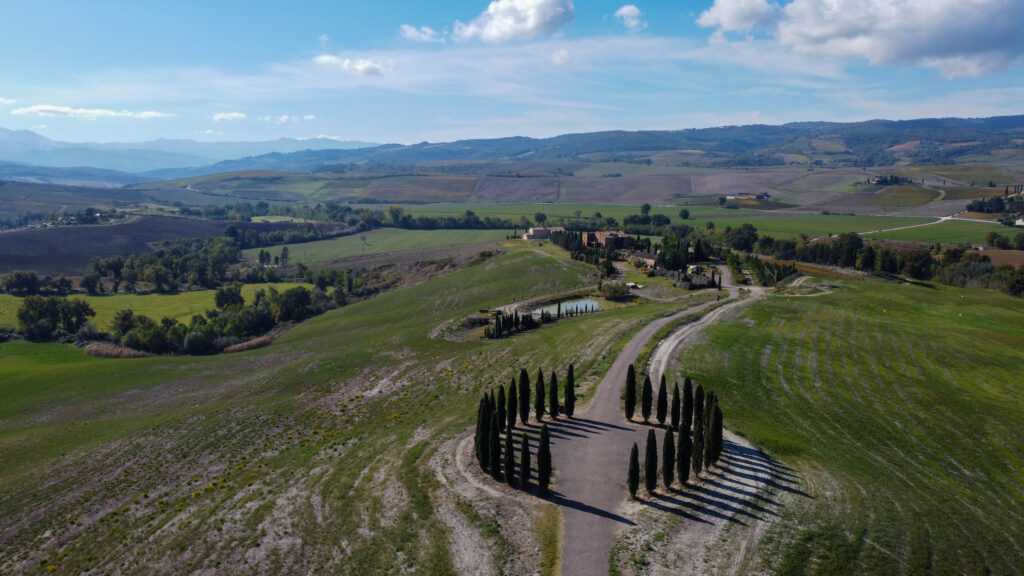
Cypress Tree Ring, Tuscany
2. Val d’Orcia – The Tuscany From Your Dreams
Val d’Orcia is the landscape that made Tuscany famous. The rolling green hills, winding roads, lonely farmhouses, and cypress trees create postcard-perfect views everywhere you look.
Best photo moments:
- Scenic roads between Pienza and Monticchiello
- Countryside viewpoints around San Quirico d’Orcia
- Farmhouses surrounded by rolling hills
Best time: Sunrise or sunset for the famous golden Tuscany glow.
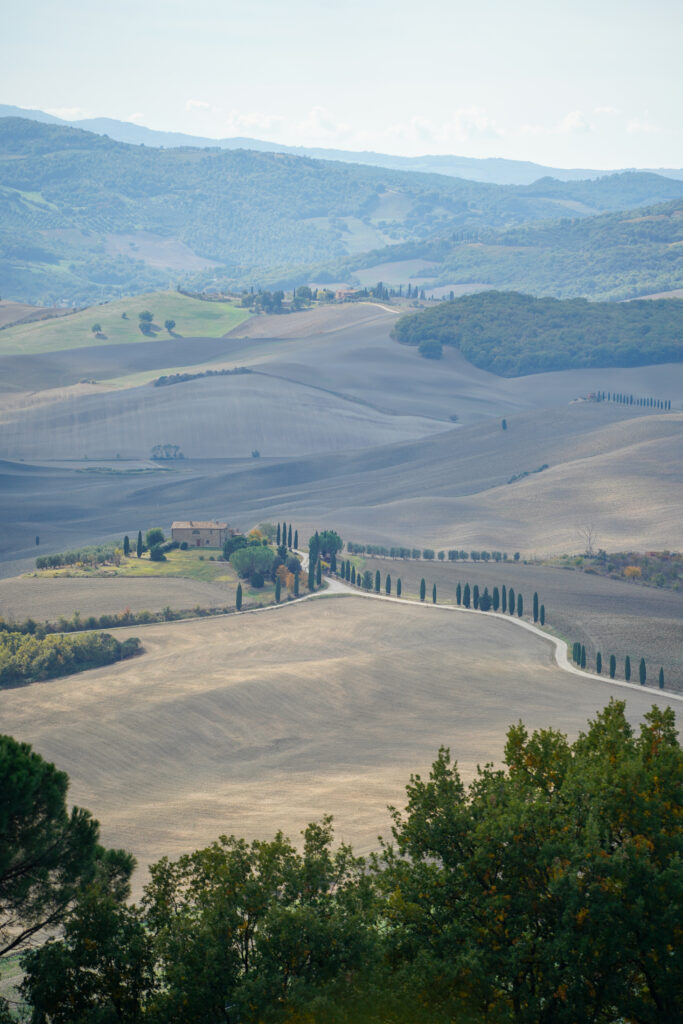
Endless rolling hills stretch across Val d’Orcia, creating the postcard-perfect scenery Tuscany is famous for.
3. Podere Poggio – A Classic Tuscan Countryside View
Tucked away in the rolling hills of Val d’Orcia, Podere Poggio captures the timeless beauty that makes Tuscany so unforgettable.
With its rustic farmhouse, cypress trees, golden fields, and sweeping countryside views, this is the kind of scene that feels straight out of a Tuscan postcard. It’s a perfect place to slow down, take in the landscape, and capture the peaceful charm of rural Tuscany.
Best photo moments:
• The farmhouse surrounded by rolling hills
• Cypress trees framing the countryside views
• Golden fields during sunrise or sunset
• Drone shots showing the beauty of the Val d’Orcia landscape
Photography Tip: Visit during golden hour when the soft sunlight creates warm tones across the hills and brings out the textures of the Tuscan countryside.
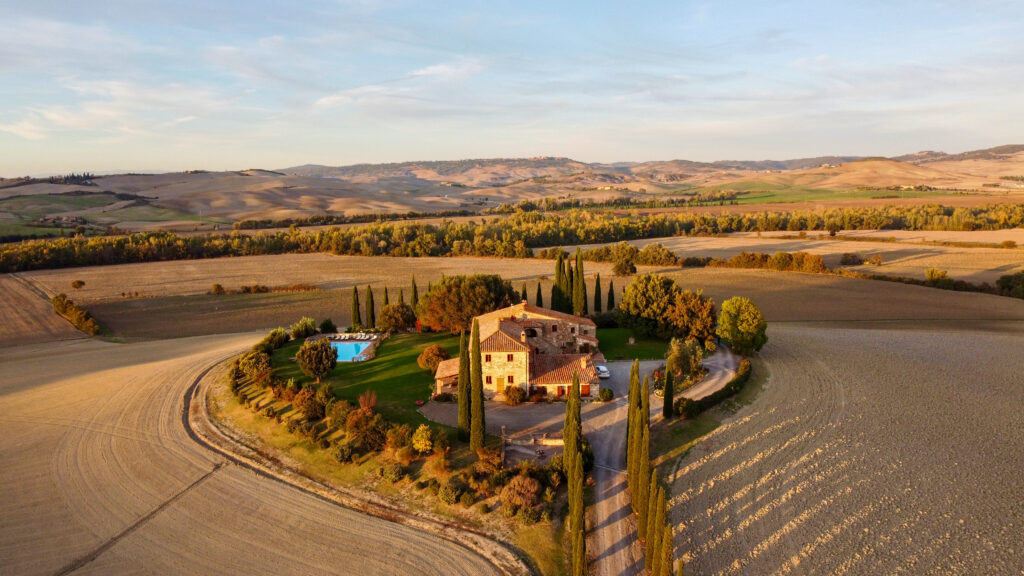
A golden glow over Podere Poggio, where the Val d’Orcia landscape feels like a painting
4. Crete Senesi – Tuscany’s Hidden Gem
Located near Asciano, Crete Senesi offers a different side of Tuscany. The soft clay hills, empty roads, and dramatic landscapes feel peaceful and untouched.
Best photo moments:
- Winding roads through the countryside
- Lone trees on rolling hills
- Wide panoramic viewpoints
5. Pienza – Medieval Charm With Valley Views
Pienza is one of Tuscany’s most beautiful hilltop villages. Beyond its charming Renaissance streets, the town offers incredible views over the Val d’Orcia countryside.
Don’t miss:
- Panoramic viewpoints along the town walls
- Quiet stone streets
- Sunset over the valley
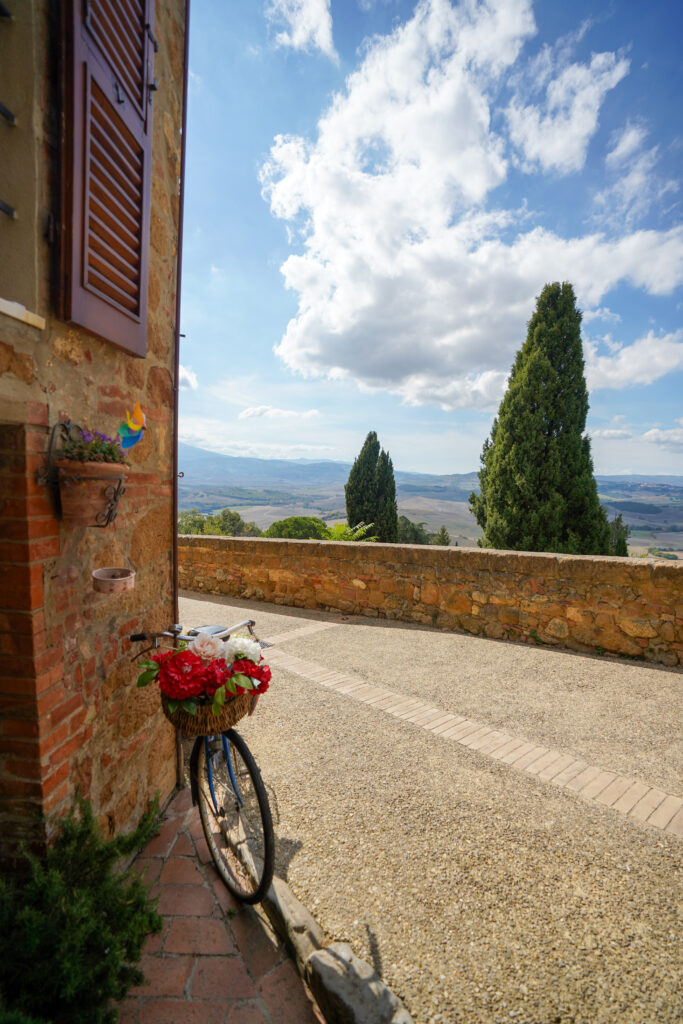
A postcard-perfect view of Pienza
6. Monteriggioni – A Medieval Fortress Frozen in Time
This tiny walled village feels like stepping into a fairytale. The stone walls, medieval towers, and surrounding countryside make Monteriggioni a perfect photography stop.
Best photo moments:
- Views from outside the castle
- Entering through the village gates
- The fortress walls
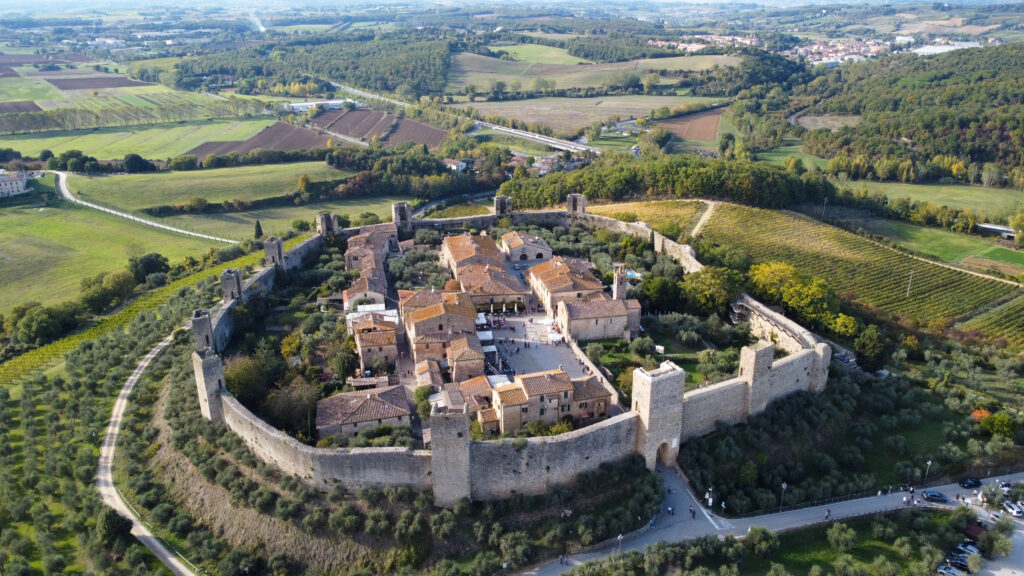
Monteriggioni from above, revealing its perfectly preserved medieval walls and timeless Tuscan landscape.
7. Pitigliano – The Village Built Into the Cliffs
Pitigliano is one of the most unique villages in Tuscany. Built dramatically on volcanic rock, the village looks incredible from the viewpoints outside town, especially during sunset.
Best photo moments:
- Golden hour views of the village cliffs
- Panoramic viewpoint before entering town
- Medieval streets
8. Saturnia Hot Springs – Tuscany’s Natural Wonder
The turquoise thermal pools of Saturnia are unlike anywhere else in Tuscany. The cascading limestone terraces and steaming water create a magical landscape.
Photography tip:
Arrive early morning to capture the pools before they become crowded.
Tuscany Photography Tips
Wake up early: The most famous spots are peaceful in the morning and easier to photograph without crowds.
Use golden hour: Sunrise and sunset create the warm light that makes Tuscany look magical.
Slow down on countryside roads: Some of our favorite photos came from unexpected stops along the way.
Save locations before your trip: Many viewpoints are not clearly marked, and having them saved on Google Maps makes exploring easier.
Wear comfortable shoes: Many villages and viewpoints involve cobblestone streets and uneven paths.
Tuscany is not just about reaching famous viewpoints – it’s about enjoying the journey, taking the scenic roads, and capturing the beauty between each destination.
Final thought
Tuscany rewards you for slowing down. It’s not about checking off boxes. It’s about stopping at viewpoints, getting slightly lost in medieval towns, soaking in natural hot springs, and sitting on a balcony watching light change across rolling hills.
3 days is enough to touch the soul of Tuscany – to understand why people spend lifetimes painting these hills, photographing these towns, and dreaming about coming back.
We still talk about our 3 days in Tuscany. We still look at the photos and you will too.
Have questions about any of these towns? Drop them in the comments below – I’m here to help you plan your perfect Tuscany trip.